


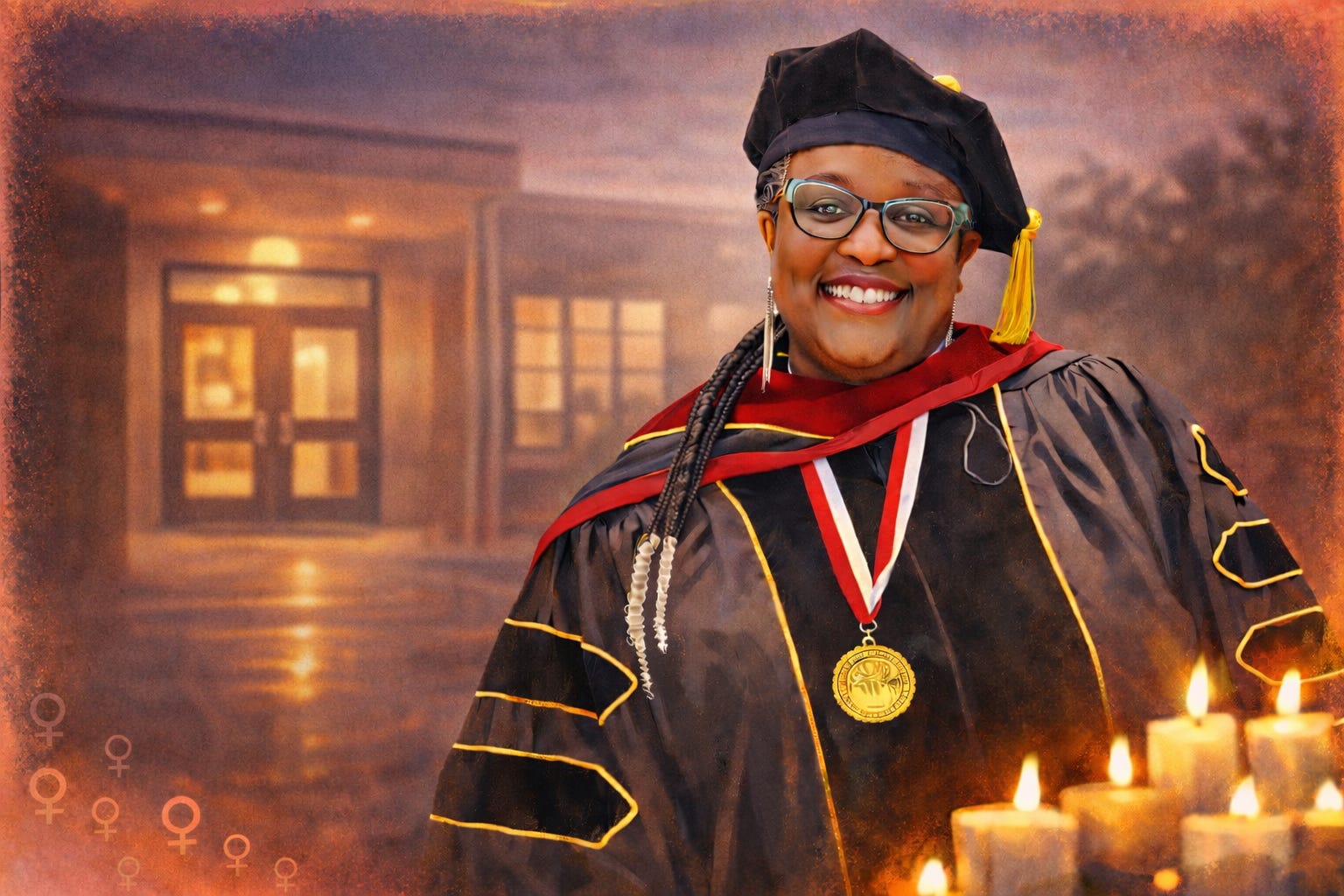
On the morning of February 16, 2026, Dr. Linda Davis was driving to work in Savannah when a vehicle fleeing federal immigration officers ran a red light and struck her car. She died from her injuries. The driver, identified by the Department of Homeland Security as Oscar Vasquez-Lopez, reportedly had received a final order of removal in 2024.
The sequence is now familiar: a traffic stop, a U-turn, a red light, a collision. The language reduces it to procedure. In seconds, a woman whose life was defined by devotion — to her students, her children, her faith — was gone.
Dr. Davis taught at Hesse K-8. Her sister described her as “the tall one,” nearly six feet, the best singer among four girls, a soprano who filled her home with Disney show tunes and laughter. She was a mother of four and guardian to another child. Former students still recognized her in the grocery store years later. Her sister wrote that the grief was “so vast it feels as though it fills the Mariana Trench.”
In that same statement, she expressed compassion for the man who killed her sister. She prayed for him and his family. She affirmed his dignity and due process under the law. It was not performative. It was Christian.
Her grace deserves respect. It also requires honesty.
For years, Americans have been told that illegal immigration is a “victimless” offense — a paperwork issue, a technical violation. But immigration law is not theoretical. A removal order left unenforced is not neutral. It is a decision. And when that decision collides with reality, the consequences are not abstract.
Georgia has confronted this before. February 22 marked the second anniversary of Laken Riley’s murder on the University of Georgia campus. Her mother, Allyson Phillips, stood at the White House this week honoring “Angel Families” and reminding the country that what happened to her daughter “could be any family.” Families who bury their children do not experience immigration policy as an abstraction.
In Savannah, only weeks before Dr. Davis’s death, 14-year-old Marcus Anderson was killed in a hit-and-run while riding his bicycle. Two men were arrested in connection with the crash and later held on ICE detainers. A detainer does not establish unlawful entry, but it does indicate federal immigration proceedings. The cases are not identical. Yet in each, immigration status became relevant only after a family had already lost someone they loved.
This is not about hostility toward immigrants. It is about governance. Every sovereign nation retains the authority to control its borders and enforce its own laws. No non-citizen is owed American residency as a moral entitlement. Lawful presence is granted through process, not assumed by crossing a border.
When enforcement is treated as cruelty, removal orders accumulate. And when removal orders accumulate, the risk is displaced onto the public.
That risk does not distribute evenly.
It falls disproportionately on women who share roads, neighborhoods, and workplaces. It falls on mothers who assume the systems meant to protect their children are functioning. It falls on a teacher driving to school before 8 a.m.
Feminism once insisted that women’s safety in public spaces was non-negotiable. We did not treat preventable harm as the cost of ideological purity. Yet when it comes to immigration enforcement, background checks and removal orders are cast as moral failings rather than basic governance.
Dr. Davis was a Black woman, a devout Christian, and — by all accounts — a person inclined toward mercy. When victims do not fit partisan narratives, urgency can fade. It should not. Her life carries the same weight as any other, and her death warrants the same seriousness.
Her sister wrote that their lives are now “inextricably intertwined” with the man who killed her. That is tragically true. But they are also intertwined with the policies that left a removal order unexecuted.
Georgia’s leaders now face a choice. After Laken Riley, there were hearings. After Marcus Anderson, there were vigils. After Dr. Linda Davis, there will be statements. The question is whether there will be reform.
A removal order should not sit unenforced until a red light is run. Law exists to prevent the moment that cannot be undone.
Women should not have to die for us to admit that illegal immigration is not victimless, and families should not be left to absorb with grace what government failed to prevent.
Dr. Linda Davis filled her home with music. She poured into children who were not her own. She loved loudly and without reservation. Honoring her memory requires something harder than sentiment: acknowledging that compassion without boundaries is not justice. It is risk transferred elsewhere.
And too often, that elsewhere has a face — a woman’s. Or a child’s.
Thank you very much for this poignant essay. Wish I could like 100 times. People who minimize or dismiss the importance of immigration enforcement don't care about the human toll.
More than a few people have been harmed and killed by illegal immigrants, who in many cases have had detainers for deportation filed on them for years. Sanctuary states ignore these detainers and release rapists, abusers, dangerous drivers, drug traffickers, and human traffickers back into society. Vehicular offenses are not considered violent crime. Most on the left couldn't care less about the victims, and in fact don't even acknowledge the frequent criminality of this cohort.
My life was changed forever after a freeway accident caused by an illegal alien. No license, no insurance, of course. He was charged, but promptly disappeared in Mexico. He undoubtedly came back later, and did the same thing. Many people don't care until it happens to them or their family.