


On July 11, Senator Lindsey Graham died. His passing reminded me of an email I sent to his office ten summers prior.
At the time I was in graduate school and had helped found a local “gender expansive” social group. Our meetings were held just down the road from Senator Graham’s district office. I wrote asking if he would meet with our group because I believed something very simple: if Republicans just met transgender people, they would change their minds. Compassion, I believed, naturally led to affirmation and that opposition was largely the product of distance and unfamiliarity. Conversation would solve things.
He never responded.
Now I wonder whether he had already seen questions that I hadn’t yet learned to ask. Not because I believe every politician is wise, but because I eventually discovered that the disagreement was never about whether transgender-identified people deserve dignity. It was about whether public policy should stop recognizing sex.
The gravity of that distinction took me years to fully understand.
I considered myself progressive. I volunteered in social justice work. Most of my closest friends came from LGBTQ and other social activist circles. I accepted gender identity as an unquestioned moral good because everyone around me did. In my Unitarian Universalist and activist circles, there was little distinction between being compassionate and being affirming. To question one often felt like abandoning the other. I believed that supporting transgender identities represented compassion in action.
Then I began noticing something that no one around me seemed willing to acknowledge. Whenever gender identity conflicted with women’s rights, women were always expected to give something up—our language, our sports, our spaces, our boundaries. The conflict was never resolved by balancing competing rights. Instead, women’s rights themselves became negotiable.
I didn’t fully allow myself to question those assumptions until I left my college-town bubble. Outside that environment it became easier to distinguish between what everyone around me believed and what was actually true. Once I stepped outside that culture, I realized that the gender racket wasn’t simply about individual identity. It was about prisons, shelters, schools, medical ethics, and the law. Ultimately, it was about whether sex still mattered anywhere government made decisions.
That realization changed the trajectory of my life. I eventually co-authored statements for the WDI USA Black Women’s Caucus, submitted testimony to the Georgia legislature, launched The Peachy Perspective, and recently had the privilege of contributing to She Holds the Line. None of that happened because I began disliking transgender-identified people. It happened because I realized that if ordinary women remain silent, policies will continue to be written as though women, as a sex class, no longer exist.
I also came to reject the increasingly common assumption that speaking truthfully about sex—or defending the rights, safety, and well-being of women and girls—is somehow an act of cruelty simply because someone else experiences it that way. Kindness and honesty are not enemies, and neither should require women to surrender the protections that exist because we are female.
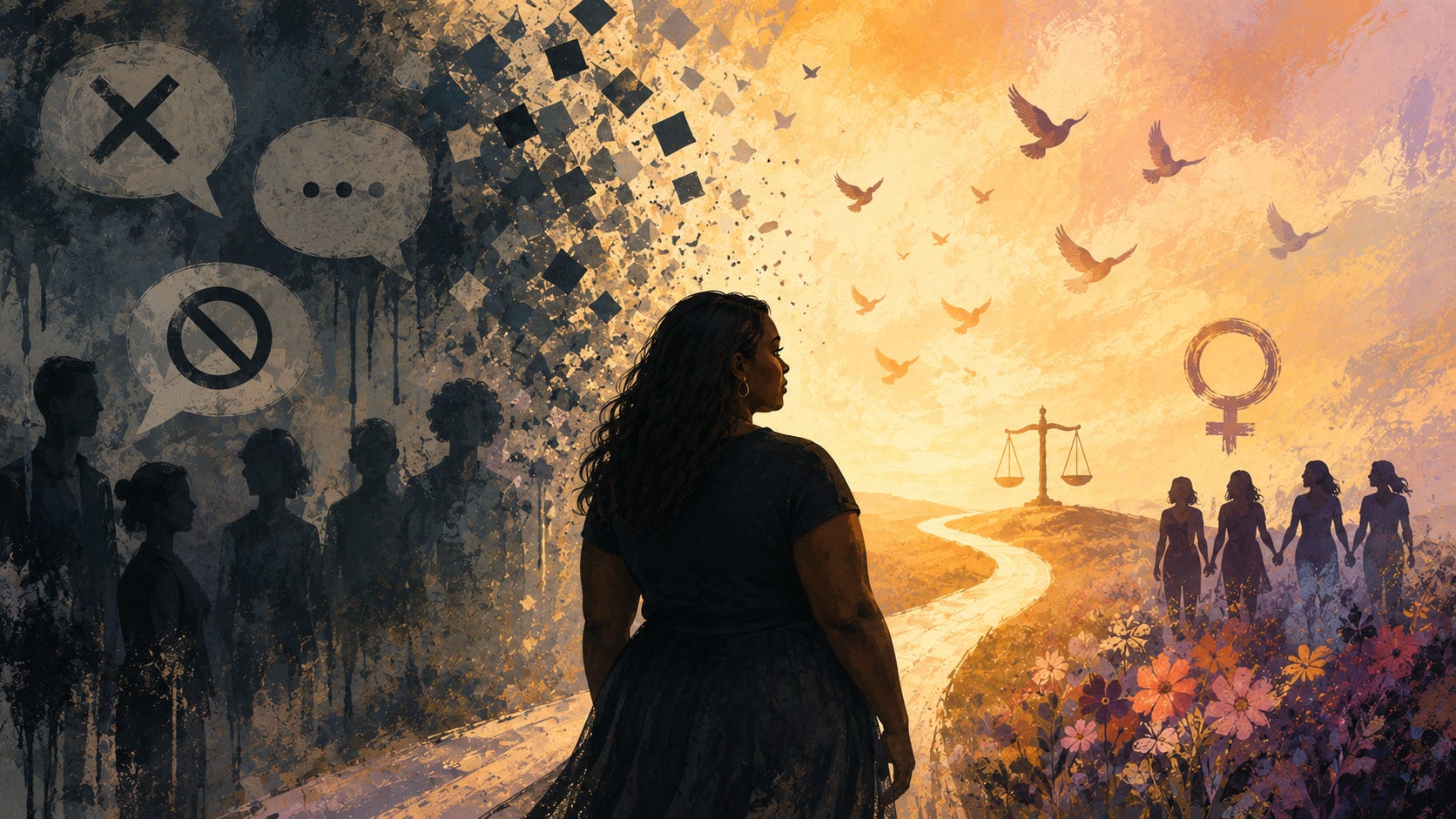
Before I experienced censorship, I experienced something far more powerful. Self-censorship.
The most effective censorship isn’t punishment; it’s anticipation. Long before anyone tells you to stop speaking, you begin editing yourself. You avoid certain conversations, stop sharing certain articles, and convince yourself that now simply isn’t the right time. By the time I had become gender-critical, nearly all of my social circles were progressive. I knew exactly what would happen if I spoke honestly.
When Magdalen Berns passed away, her final appeal—that women keep speaking the truth after she was gone—stayed with me. She wasn’t asking women to be fearless. She was asking us to decide whether fear should make our decisions for us.
Unlike many women, I occupied a fortunate position. I was self-employed. Speaking publicly wasn’t likely to cost my career or my family’s health insurance. Many women aren’t so fortunate. I realized I had been quietly hoping braver women would carry risks that I was uniquely positioned to take myself.
Deleting my Facebook account and starting over the day after the world lost Berns felt easier than explaining to most of my friends why my views had changed. For a while I remained only silently gender-critical, but by the summer of 2020, silence stopped feeling morally neutral, and I began openly sharing gender-critical writing.
The costs arrived almost immediately. Friendships disappeared. Former colleagues from social justice circles publicly mocked me. One man I had known through activist work sarcastically asked whether I believed “trans women are invading women’s spaces.” After I shared feminist quotations defending women’s rights, he responded, “Jesus Christ you really are a f*****g s**t.” Women were generally less overtly hostile, but no less clear. They’d either just ghost me or attempt to get me to recant, call me a TERF when I didn’t, then block me immediately. Whether expressed through profanity or silence, the message was the same: my views made me no longer welcome.
The institutional consequences followed. In 2024, after gaining enough confidence to begin publishing essays under my own name, Medium permanently revoked my membership and account after I criticized policies that allowed a male offender into a women’s shelter, where he stabbed a female shelter worker with a sword after being asked to leave. The next year, while pregnant with my first child, I found myself banned from pregnancy groups for defending what should have been the least controversial observation imaginable: motherhood is an exclusively female status. The feelings of men who were not even members of those groups ultimately carried more weight than a first-time pregnant woman’s need for access to information.
Looking back, I realize my own experience wasn’t unusual. It was simply smaller. The same pattern that operated within friendships, activist circles, and online communities eventually reached some of our largest institutions.
That is why recent events involving Amnesty International UK matter far beyond one organization. Amnesty recently withdrew a report after widespread backlash over its decision to characterize numerous gender-critical organizations—including charities, victim-support groups, evidence-based medical organizations, and grassroots volunteer networks—as part of an “anti-rights movement.”
What struck me wasn’t merely the report itself but how familiar the underlying logic had become. First disagreement becomes prejudice. Then prejudice becomes harm. Then harm becomes justification for excluding dissent altogether. Once disagreement itself is treated as harm, dialogue is no longer necessary.
The remarkable part is not that Amnesty published such a report. The remarkable part is that it had to retreat. Organizations including For Women Scotland, Sex Matters, LGB Alliance, Gay Men’s Network, Children of Transitioners, and others refused to quietly accept being defamed. Rather than apologizing simply for being accused, they demanded evidence, accountability, and a return to genuine human rights principles. They insisted that human rights organizations defend pluralism instead of ideological conformity.
That shift bolsters my hope.
It also struck me that all of this unfolded during an unusually reflective week. Within days of one another, Senator Lindsey Graham passed away, Amnesty International found itself retreating from an attempt to delegitimize gender-critical advocacy, and Bonnie Atwood quietly left us after a lifetime of feminist work.
I didn’t know Bonnie personally, though I had the pleasure of hearing her speak during several Zoom meetings, and I know women whose lives she touched much more directly than mine. One of the early voices of the Women’s Liberation Movement, she spent decades writing, organizing, advocating, and insisting that women’s lives deserved to be described honestly—even when those truths challenged powerful institutions or prevailing orthodoxies.
Reading about her life again this week, I was struck by how little the central responsibility of feminism has changed. Bonnie’s generation fought to create a language for realities polite society preferred women not discuss. My generation has inherited a different set of taboos, but a remarkably similar obligation. Every generation of women eventually discovers that there are truths society would rather we leave unsaid.
Looking back, I think about that unanswered email to Lindsey Graham and how for years I believed the answer to disagreement was simply getting people into the same room. I still believe conversations matter, but I’ve learned that conversation alone cannot answer the central question. People can hear the same facts, meet the same people, and arrive at different conclusions because they begin from different understandings of justice.
The real question is not whether someone has met transgender-identified people. I had, and many of my friends were. The real question is whether women’s rights remain rights when they conflict with someone else’s identity. That was the question I couldn’t yet see when I wrote that email.
I no longer believe that speaking truthfully about sex, motherhood, or women’s rights is an act of unkindness simply because someone else experiences it that way. Nor do I believe that defending women and girls requires apologizing for doing so.
Ten years ago, I thought one conversation with a senator might change the course of this debate. Today, I think lasting change happens differently. It happens one woman at a time deciding that the cost of silence has finally become greater than the cost of speaking.
If recent events—from the Supreme Court to Amnesty International’s retreat—are any indication, more women are making that same decision. I hope Bonnie Atwood would recognize that as progress.
“Today, I think lasting change happens differently. It happens one woman at a time deciding that the cost of silence has finally become greater than the cost of speaking.”
So very true. This is quite simply all we can do.
Thanks so much for this essay. I hope the path you’ve followed, the trajectory of your thinking is reflective of a pattern of growth we’ll see become increasingly public— the sooner the better.