


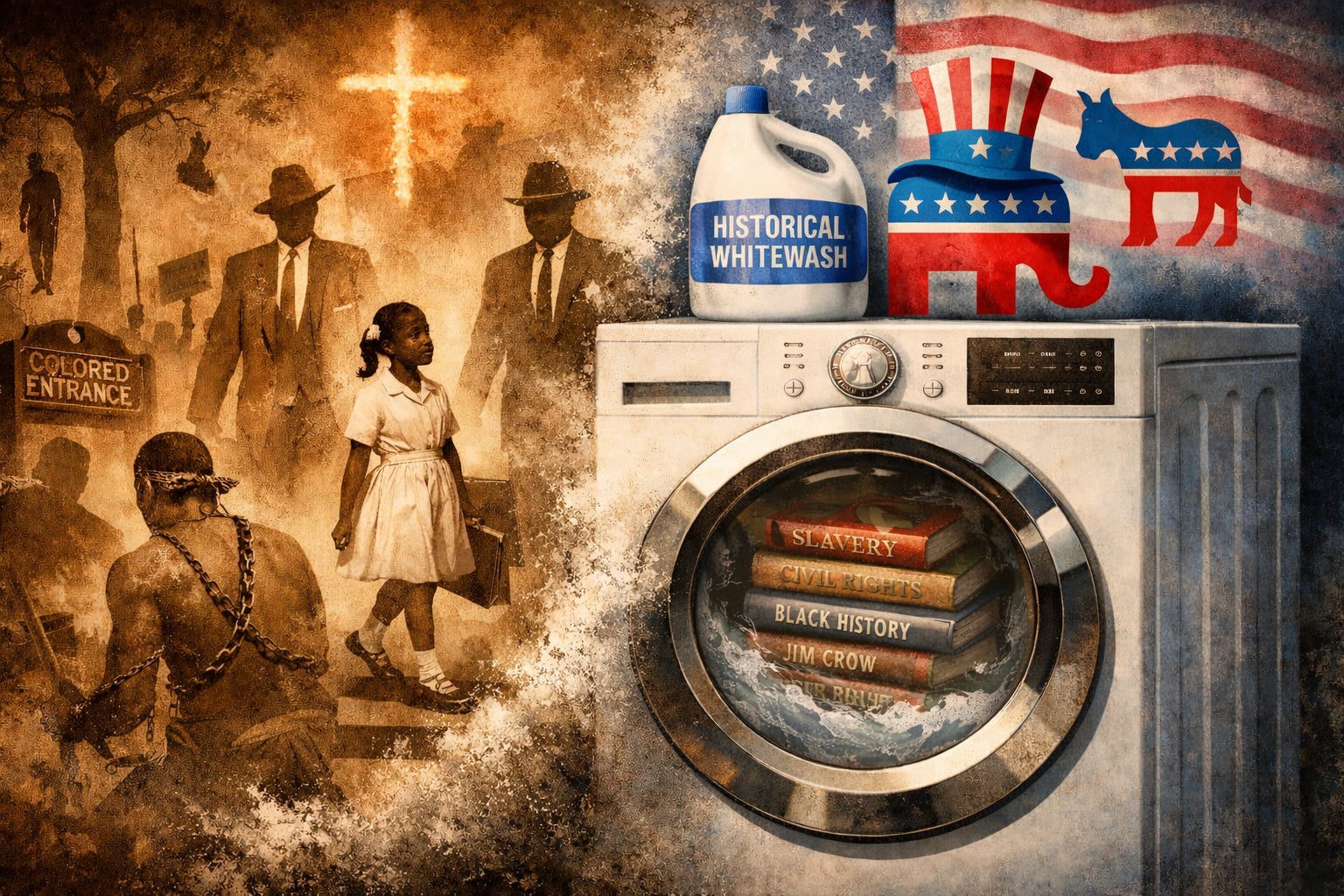
A few years ago, I wrote an essay titled Beyond Tokenism: Challenging the Exploitation of Black Struggles in Gender Debates. The argument was straightforward: Black suffering is not a public utility. Our history is not a rhetorical shortcut. Our trauma should not be summoned whenever someone needs emotional force for an argument that has nothing to do with us.
What I did not anticipate was how much worse this habit would become.
Across the political spectrum, Black American history is now routinely treated as a grab-bag of metaphors. When an argument needs urgency, someone reaches for slavery. When a conflict needs moral weight, someone invokes Jim Crow. When a debate needs shock value, someone reaches for the N-word—not because the analogy fits, but because Black history still carries unmatched emotional power.
What’s happening here is the laundering of political arguments through Black history—the habit of borrowing Black suffering to give unrelated arguments instant moral authority.
Shock Value as Political Currency
Recently, I came across a comment regarding self-identity debates claiming that the word “cis” is the “LGBTQ+++ mafia’s N-word for all of us.” The statement was meant to provoke, to scandalize, to flatten centuries of racial terror into a clever comparison. It did none of those things well.
The N-word is not a generic insult. It is a word forged to justify enslavement, rape, segregation, and lynching. It carries the moral weight of a caste system enforced by law and violence. A descriptive term used in identity discourse does not occupy the same universe, morally or historically. Treating them as equivalent is not radical. It is highly unserious, historically illiterate, and deeply anti-Black.
The right does the same thing, only with different symbols.
Recently, some conservative commentators compared Minnesota Governor Tim Walz’s refusal to cooperate with federal immigration enforcement to George Wallace blocking school desegregation. On paper, both involve states and federal authority. In reality, the analogy collapses immediately. Segregation was not an abstract constitutional disagreement. It was a system designed to deny Black people their humanity. Ruby Bridges did not walk through screaming mobs so her story could become a reusable prop for modern partisan disputes.
These comparisons are not attempts to clarify. They are attempts to borrow moral gravity.
Immigration, Slavery, and the Lie of Equivalence
Nowhere is this habit more grotesque than in immigration politics.
Activists regularly describe ICE as “slave catchers,” and tweets circulate claiming immigration enforcement is simply what America has been doing to Black people “for 400 years.” Even Norman Rockwell’s painting of Ruby Bridges has been AI-altered to place an immigrant boy beside her, recasting a singular moment of Black courage as a tool for someone else’s narrative.
This is not poetic license…this is historical abuse.
My ancestors were owned as property. They were hunted for trying to escape the shackles imposed on them in a land they were dragged into by force. They had no visas to overstay, no borders to cross, no legal pathway to pursue. Chattel slavery was a hereditary caste system enforced by law, commerce, and terror. Illegal immigration, whatever one’s politics, is not that.
Calling ICE “slave catchers” erases the specificity of Black bondage while laundering contemporary arguments through the most sacred trauma in American history. It converts slavery into a metaphor, and Black people into tools.
If your cause is just, it should not require stealing ours.
Selective Outrage and Disposable Black Victims
The exploitation does not stop at language. It shapes whose suffering counts. And the consequences are not theoretical.
When U.S. citizens Renee Good and Alex Pretti were killed during federal operations in Minneapolis, the outrage was immediate and national. Protests followed. Statements poured in. Moral collapse was declared. Their deaths—caught on camera and widely reported—became part of a national conversation about the use of force by immigration agents.
But whose suffering draws attention often depends less on human life than on rhetorical utility.
Across the country, everyday Americans have been killed in violent incidents involving non-citizens who, according to authorities, were in the country without legal status. Seven-year-old Ivory Smith in Texas was murdered when a drunk-driving illegal immigrant—reportedly released from an ICE detainer—slammed into her vehicle while she was out with her family. Larisha Sharell Thompson, a South Carolina mother of two, was shot to death by a group of six undocumented teenagers and young adults, according to law enforcement. And when Dacara Thompson, a Black woman, was murdered by an illegal immigrant in Maryland, there were no comparable national protests or campaigns. No sustained outrage. No reckoning.
This pattern has become painfully familiar. Black suffering is amplified when it supports fashionable causes and quietly ignored when it complicates them. “Black and brown” becomes a slogan that often means everyone but Black. The selective reservoir of empathy on the national stage reveals a harsher truth: some victims count because they serve the moral framing of a political moment, while others disappear because they do not.
Many Black Americans see this clearly now. “Use your own history,” one woman wrote online. If you are on the right side of history, that should be enough.
She is right.
Georgia and the Politics of Convenience
Here in Georgia, the selective outrage becomes impossible to miss.
Just this week, our senators took to social media and public statements to threaten a government shutdown over the fatal shootings of U.S. citizens Renee Good and Alex Pretti by federal immigration agents in Minneapolis—deaths that have sparked protests and a national debate about federal enforcement tactics and oversight.
Sens. Jon Ossoff and Raphael Warnock invoked moral crisis and constitutional collapse, denouncing ICE as lawless and dangerous and pressing for dramatic changes to how immigration enforcement is funded and conducted.
Yet in the very same state they represent, when an illegal alien reportedly forced his way into a Georgia mobile home and raped an eleven-year-old girl at knifepoint—an attack that occurred less than a week ago—there was no comparable urgency. No sweeping statements. No press conferences. No national mobilization.
This is not about principle. It is about narrative utility—about which suffering can be mobilized, and which can be ignored.
I support national sovereignty. I support immigration enforcement. America is not Section 8 housing for the world. That does not mean I support reckless federal tactics or the killing of American citizens. One can oppose government overreach while still supporting deportation. One can demand accountability from agents and still believe that any non-citizen may be removed for any reason.
This is how narrative utility works: outrage is not guided by principle, but by which stories are politically useful.
Intersectionality Without Boundaries
This is the deeper failure of how intersectionality now operates in public discourse.
Why are Black Americans always the default example? Why does our suffering function as the universal moral yardstick? Why are slavery, Jim Crow, and civil rights endlessly recycled to explain conflicts that have nothing to do with us?
This is not representation. It is exemplary scapegoating. Black history is used as a moral proxy so other movements can inherit authority without inheriting cost.
The result is flattening, distortion, and exhaustion. Our past becomes a debating trick. Our trauma becomes portable.
Without Euphemism
And this is what needs to be said without euphemism.
Stop calling ICE “slave catchers.”
Stop rewriting Ruby Bridges.
Stop comparing every political dispute to Jim Crow.
Stop reaching for anti-Black slurs for shock value.
If you want to argue about immigration, argue about immigration.
But leave Black history out of it.
Our ancestors did not suffer so you could win an argument. And we are done being your analogy.
Brilliant. Your writing brings into focus facts that most don’t have the courage to articulate from any community- left or right. As for using the N word in comparison to the dreaded “cis” word- it is carelessly hyperbolic.
I heard someone articulate on Substack the perfect way to think about that dubious prefix: “The term “cis” is hate speech invented by trans activists to pretend women are a “subset” of women. We are the only type of woman. No man can become a woman. Humans cannot change sex”. Simple, easy and you don’t have to rent someone else’s experience or history to make your point.
Anyway, thank you for writing this.
Excellent piece. I read a similar thing this morning from the Jewish perspective, who feel the same way about how their painful history is appropriated for rhetorical gotchas.