


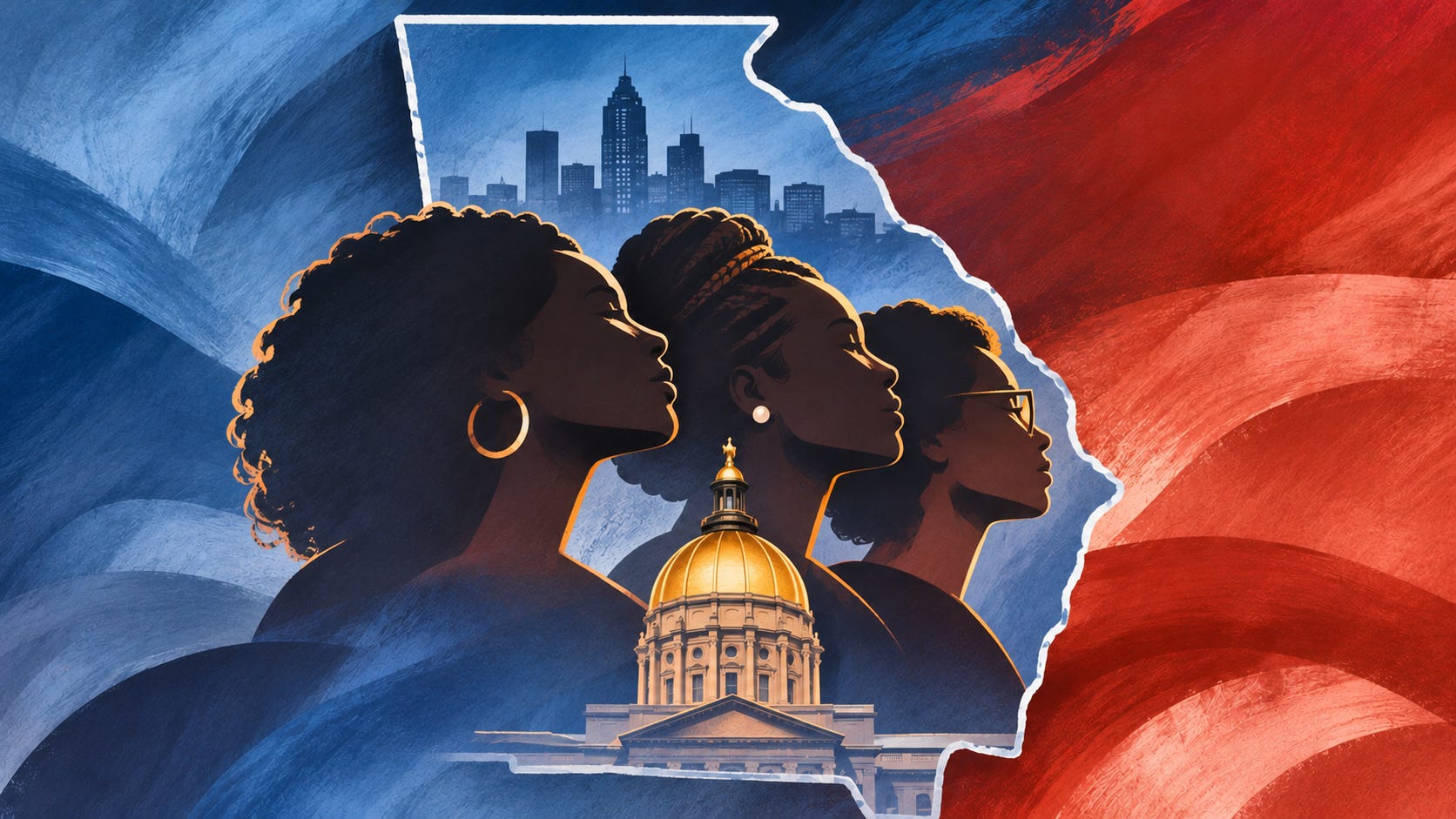
Georgia made history last Tuesday. Democrats swept every statewide office on the ballot, flipped the state House of Representatives, and reelected Senator Jon Ossoff by an overwhelming margin. Keisha Lance Bottoms became the first woman elected governor of Georgia and the first Black woman elected governor of any American state. Across the ballot, Black women claimed positions of political power that would have been difficult to imagine in Georgia just a generation ago.
It’s an extraordinary transformation for a state that voted for Donald Trump only two years earlier and has spent more than two decades under Republican governors. While I have serious disagreements with many of the Democrats who will soon lead our state, the significance of what happened shouldn’t be dismissed simply because I disagree with their policies. But as the celebrations continue, I find myself wondering what, exactly, Georgians voted for.
Did hundreds of thousands of voters suddenly embrace progressive policies…or did they grow so frustrated with Republican leadership, corruption, and political dysfunction that they were willing to give the opposition a chance? I suspect the answer is more complicated than either party would like to admit.
A Rejection Is Not an Endorsement
The scale of the Democratic victories is difficult to overstate. Ossoff defeated Republican Mike Collins by approximately three-quarters of a million votes. Bottoms won by more than 360,000. Other statewide Democrats also won by hundreds of thousands of votes. These weren’t victories decided by a handful of precincts.
National exit polling offers some clues about voter motivation. CBS News found that roughly nine in ten voters considered government corruption a major factor, approximately the same proportion who identified the cost of living as important. Dissatisfaction with the country’s direction and President Trump’s leadership also weighed heavily on the electorate. That doesn’t mean voters rejected Democratic policies, but neither does it establish that they embraced them.
Republicans would be foolish to ignore that distinction. They had opportunities to make compelling arguments about public safety, economic opportunity, and Democratic policies. Instead, national controversies and the baggage surrounding individual candidates made those arguments difficult to separate from the people delivering them. Consider Georgia’s Senate race. Collins had the Laken Riley Act, named for a young Georgia woman murdered by a Venezuelan national who entered the country illegally, as an obvious campaign issue. Yet his candidacy was burdened by an ethics investigation and controversies involving people around him. Voters were being asked to overlook questions about Republican credibility while trusting the party to hold its opponents accountable.
Ossoff, meanwhile, won another six years despite voting against advancing federal legislation protecting female-only school sports categories. He also supported the final Laken Riley Act after previously opposing related immigration-enforcement measures. His victory doesn’t mean voters approved of every decision. It means they weighed those decisions against the alternative. Winning an election establishes who gets to govern. It doesn’t establish that every position held by the winner has suddenly become the will of the people.
Black Representation, Black Expectations
There is something remarkable about the number of Black women Georgians have elected to statewide leadership. A state whose history includes slavery, segregation, and the systematic exclusion of Black Americans from political power will now be governed by a Black woman, alongside others holding substantial influence over Georgia’s future. These milestones deserve recognition. But representation is not the same thing as results, and celebrating the former cannot substitute for delivering the latter.
Atlanta offers a useful reminder. Black political leadership has defined the city for more than fifty years, beginning with Maynard Jackson’s election as mayor in 1973. That leadership expanded opportunities and political influence, yet persistent disparities in housing, wealth, education, and neighborhood investment remain. Representation creates opportunities to address longstanding problems, but it cannot do the work of governing.
I also wonder whether Democrats sometimes misunderstand the voters who make their success possible. Black Americans have been among the party’s most dependable constituencies for generations, but political loyalty shouldn’t be confused with ideological uniformity. Many Black voters are religious, culturally traditional, economically pragmatic, or otherwise more moderate than the party’s most progressive activists. Supporting Democratic candidates doesn’t necessarily mean agreeing with every position promoted by national advocacy organizations or political donors.
Perhaps Georgia’s new leadership has an opportunity to recognize that distinction. What if Black women in power challenged the expectation that supporting women requires accepting every claim made in the name of gender identity? What if Democrats acknowledged concerns about immigration enforcement without dismissing them as hostility toward immigrants? What if economic mobility, educational opportunity, and family stability became more important measures of progress than ideological conformity? Those shouldn’t be unreasonable expectations for a party claiming to represent such a diverse coalition.
The Freedom to Govern Differently
One of my hopes following this election is that Georgia Democrats will discover something increasingly scarce in their party…the freedom to disagree with their own side. Supporting female-only sports categories is treated as Republican. Expressing concern about immigration enforcement is treated as conservative. Questioning influential advocacy organizations can invite accusations of disloyalty…but none of these concerns belong exclusively to one political party.
Consider a September election guide published by transgender-rights activist (and male) Erin Reed, identifying Democrats whose positions on transgender issues he opposed. The list included candidates who supported female-only sports categories or restrictions on medical transition procedures for minors. Reed argued that allowing such positions to gain acceptance within the Democratic Party posed a “threat to transgender Americans” rights and protections more permanently than a Republican victory. He also discussed withholding votes from certain Democrats even at the risk of electing Republicans.
That is one illustration of the pressure Democratic candidates can face when they depart from an advocacy movement’s priorities. But a party claiming to represent a broad coalition must also make room for disagreement within it.
Bottoms has said she would have vetoed Georgia’s Riley Gaines Act, which established sex-based protections for female school sports. That concerns me, particularly because some Democrats supported the legislation despite their party’s opposition. Protecting female athletic opportunities shouldn't be incompatible with supporting women more broadly. Women's sex-based rights should not become negotiable simply because defending them creates discomfort within a political coalition.
Bottoms’s statements about immigration enforcement raise similar questions. Bottoms has indicated she intends to push back against federal immigration policies, pointing to her decision as Atlanta mayor to end the city’s detention agreement with ICE. Ending a detention contract isn’t the same as refusing all cooperation with federal authorities, but Georgia’s next governor should explain where political opposition ends and public-safety responsibilities begin.
The murder of Laken Riley remains a painful reminder that failures involving immigration enforcement and criminal justice can carry consequences far beyond political talking points. Georgians deserve clear answers about how their government intends to protect residents while navigating disagreements with Washington.
I don’t expect Democrats to abandon their platform because they won. But I hope their newfound strength gives them room to reconsider positions that may be more popular among advocacy organizations and national donors than among their constituents.
Political independence shouldn’t require changing parties. It should simply require the willingness to tell one’s own party no.
What Progress Could Actually Look Like
I want Georgia’s new leadership to succeed. Not because I’ve embraced the Democratic platform, but because I live here, I’m raising my daughter here, and their decisions will affect our lives long after election night.
I want families to afford homes, small businesses to grow, and good schools and safe neighborhoods to be accessible regardless of ZIP code. I want women to pursue careers, raise children, and participate in public life without having their contributions as mothers and caregivers treated as incidental.
Women are central to our communities' economic and social stability. We are workers, business owners, mothers, wives, and caregivers, often carrying responsibilities that society depends upon but rarely values adequately. Policies that make our lives more secure benefit everyone who depends on us. That includes healthcare, childcare, economic opportunity, and safe communities. It also includes recognizing sex-specific interests that cannot always be accommodated by pretending biological differences are irrelevant.
These priorities aren’t inherently contradictory. A government can support women in the workplace while recognizing motherhood’s importance. It can encourage economic opportunity while protecting female athletic categories. It can welcome immigrants while maintaining meaningful immigration enforcement.
With a Democratic governor, lieutenant governor, and House majority, the party will have more influence over Georgia than it has enjoyed in decades. Republicans will retain a narrow state Senate majority, making compromise necessary. Perhaps that divided legislature will encourage practical governance rather than ideological posturing.
A Mandate to Represent, Not Radicalize
Last week, I wrote about political parties selectively defending women’s interests while expecting unconditional loyalty. I argued that women shouldn’t have to choose between fair athletic competition and meaningful investment in women’s sports, or between representation and recognition of our sex-based rights.
The election hasn’t changed my mind. But it has changed the political circumstances in which those expectations must be defended.
Georgia’s voters have given Democrats an extraordinary opportunity, and I don’t intend to spend the next four years assuming every decision they make will be wrong. I’d rather see them govern with enough independence to challenge the ideological pressures that have made their party increasingly difficult for women like me to support.
Perhaps the voters who delivered this blue wave are more moderate than the activists who claim to speak for them. Perhaps Georgia’s new Black women leaders will prioritize families and communities over national political movements. Perhaps Democrats will rediscover that representing a diverse coalition sometimes means disappointing its loudest members.
Or perhaps they’ll mistake their victories for permission to pursue the same ideological priorities that have alienated voters like me.
Republicans, meanwhile, should recognize that voters cannot be expected to overlook questions of character, accountability, and competence simply because a candidate holds positions they agree with. A party that cannot earn the public’s trust shouldn’t assume its opponents’ unpopularity will save it.
I don’t know whether Georgia’s blue wave represents a lasting realignment or a temporary rejection of Republican leadership. But the people taking office will govern a state whose residents are more diverse in their beliefs than either party’s most enthusiastic supporters acknowledge.
Georgia has made history. I hope its new leaders understand that the significance of their victories will ultimately be measured by what they accomplish for the people who elected them, not simply by the barriers they broke along the way.
Georgia voted blue. Whether it voted left remains an open question.