


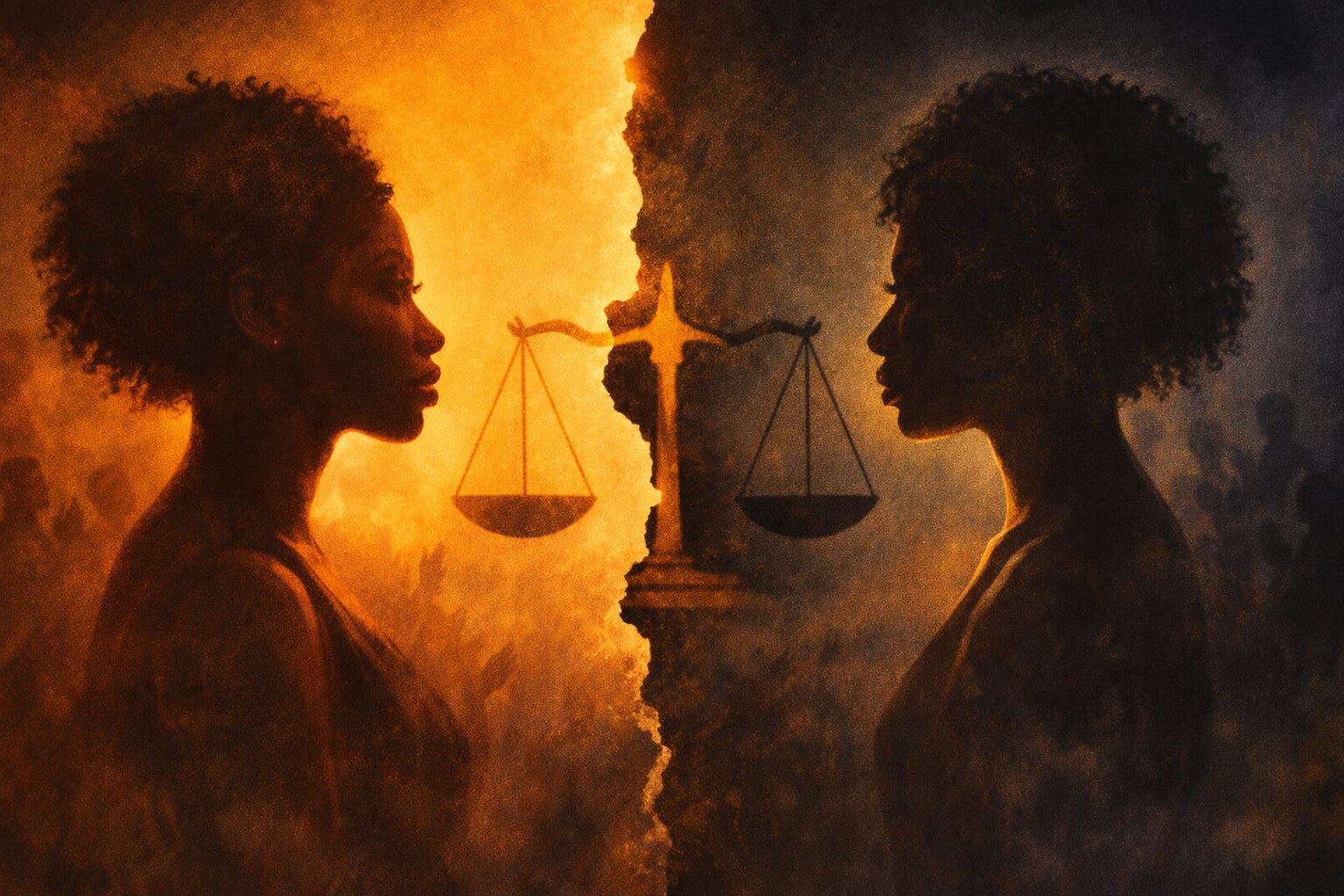
Several months ago, I wrote about permission structures—the mental shortcuts that allow us to treat other people as disposable once we have labeled them morally suspect. The process is simple: disagreement becomes “harm.” A label replaces curiosity. And once someone is categorized as dangerous, misguided, or traitorous, withdrawing dignity or defense begins to feel justified.
At the time, I was thinking about private life—friendships strained by politics, conversations shut down by clichés. But permission structures do not stay private. They scale. They migrate into institutions. They surface on public stages.
In recent weeks, two very different stages exposed something about hierarchy — not identical harms, but identical instincts. One revealed how communities discipline. The other revealed how communities defend.
The NAACP Stage
At the NAACP Image Awards — a ceremony meant to celebrate Black excellence — Nicki Minaj became the subject of a joke. The remarks were not devastating. It was simply disrespectful, and notably out of place at an event designed for elevation rather than correction.
That distinction matters.
Public figures are fair game for critique. Nicki Minaj is not beyond scrutiny. Her public defense of a husband with a sexual assault conviction raises serious moral concerns, and Black women are justified in questioning how her loyalty to men in her life who have harmed women and children can perpetuate harm. But what unfolded on that stage was not a substantive reckoning. It was a signal. A shorthand distancing. A reminder that she had strayed, politically.
The significance was not the severity of the joke, but the ease of it. A celebratory platform felt comfortable participating in ideological correction.
This is where permission structures enter quietly. Once a woman is labeled politically wayward, disrespect feels permissible. The label does the thinking: “lost,” “co-opted,” “dangerous.” Disagreement is reframed as moral failure. And once moral failure is assumed, public diminishment feels justified.
The issue is not that Nicki Minaj was gravely harmed. It is that a space meant to uplift Black achievement felt no hesitation in disciplining a politically inconvenient Black woman.
That comfort reveals hierarchy.
The Asymmetry
The hierarchy becomes clearer when we compare how Black men who depart from mainstream Democratic politics are treated.
Kanye West has been criticized relentlessly. But he is also framed as mercurial, complicated, independent. Ice Cube is described as strategic when he engages across party lines. They are controversial. They are mocked. But they are still treated as individuals exercising agency.
Black female dissent is more likely to be framed as betrayal. The reaction shifts from “I disagree” to “You have abandoned us.”
Black women occupy a distinct moral position within the community. We are described as the backbone, the conscience, the most reliable voting bloc. That praise carries expectation. When Black men diverge, they are autonomous. When Black women do so, they are destabilizing the collective.
The stakes feel higher because we are expected to carry the moral weight of everyone.
The BAFTA Baseline
The recent BAFTA ceremony provided a different kind of clarity.
When Michael B. Jordan and Delroy Lindo were subjected to a racial slur during the broadcast, the Black American community rallied swiftly and without hesitation. There was no audit of their political affiliations. No inquiry into their ideological consistency. No conditional extension of solidarity.
They were defended as Black men who had absorbed harm on a global stage. Full stop.
That clarity matters. It establishes a baseline: when harm is recognized, protection can be immediate and unified.
Which raises an uncomfortable question.
If a politically inconvenient Black woman had stood alone on that stage and absorbed that same slur, would the response have been equally unqualified? Or would permission structures have intervened first, prompting a quiet evaluation of her prior statements, her affiliations, her deviations?
We have seen how quickly such audits occur. Women who refuse to affirm dominant narratives—particularly around gender ideology—are not merely debated; they are labeled harmful. The label authorizes dismissal. Disagreement is reframed as violence. Solidarity is withdrawn with moral confidence.
The issues differ. The architecture does not.
Nicki Minaj is not a martyr, and no public figure is entitled to uncritical loyalty. The question is not whether she should be shielded from criticism. The question is whether the communal reflex is consistent.
Do we defend Black women as a principle?
Or only when they reinforce our preferred political narrative?
Permission structures thrive on certainty. They tell us that once someone is on the “wrong” side, ordinary standards of empathy no longer apply. They allow us to convert disagreement into moral failure, and moral failure into disposability.
If “protect Black women” is to mean more than a slogan, it must withstand ideological divergence. It must extend beyond the agreeable and encompass the inconvenient. Otherwise, protection becomes performance—contingent upon compliance.
Communities are not measured by how they treat those who echo them. They are measured by how they respond to those who complicate them.
When protection evaporates the moment a Black woman deviates politically, that is not solidarity.
It is discipline.
And discipline is how obedience is enforced.
I definitely agree that "Protect Black Women" revealed itself as an empty slogan a long time ago, like mid-2020. Actually, I don't see people using it that much anymore. And yes, black men do get more of a pass for their divergent views.
As far as the lack of protection for gender critical women and citing Nicki Minaj as an example-I do want to say that black people will turn their backs on people who turn their back on the black community.
Nicki Minaj did made more than just a statement on gender ideology; she performatively aligned herself with white conservatives on a number of issues, some of which impact the black community.
To date, we have not seen any examples of otherwise pro-black, black female public figures who speak against gender ideology and are swiftly turned against by the black community as a whole.
I don't really envision that sense of betrayal-backlash happening outside of snobby blackademic and "queer" circles, where black issues are force-teamed with trans issues. Most black people agree with Nicki on the trans child issue. She could have just left it there, but she had to lay her ass down for these white folks.