


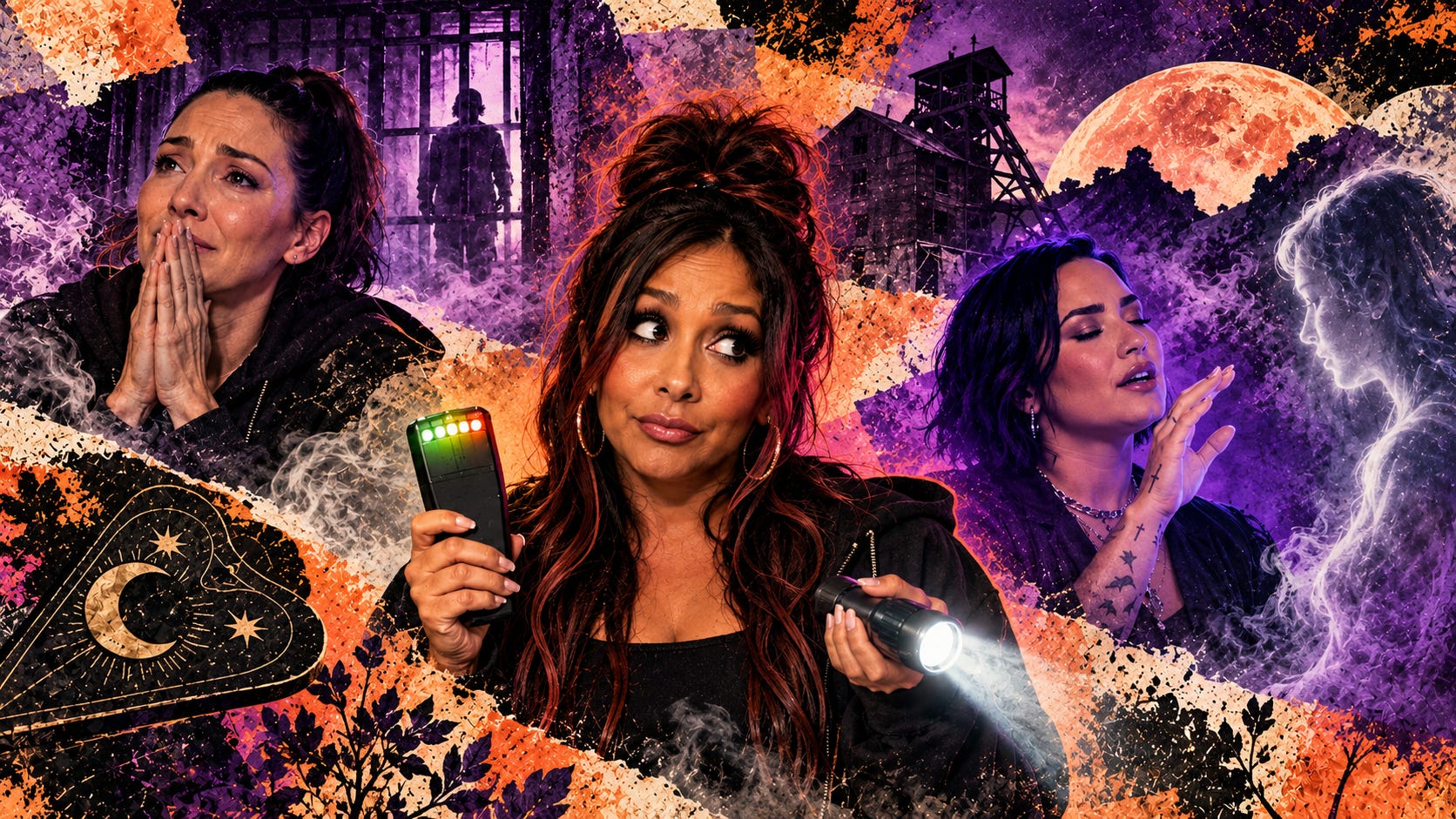
I’ve enjoyed Snooki: The Paranormal Rookie, a new ghost-hunting series starring Nicole “Snooki” Polizzi of Jersey Shore fame. I wasn’t a faithful viewer of Jersey Shore, much less its seemingly endless spinoffs, but there’s something oddly comforting about seeing Snooki on my television. Maybe it’s the millennial nostalgia talking, but watching someone so obnoxiously millennial bring that unapologetic energy into an entirely different environment does my heart good.
I find it delightful that seventeen years after becoming famous for drunken antics on the Jersey Shore, Snooki is now wandering through allegedly haunted Canadian buildings trying to communicate with what she affectionately calls “ghosties.” It’s an unlikely career trajectory, but somehow it works. Snooki is still Snooki…the scenery has simply gotten spookier.
Her latest venture reminded me of two other celebrity paranormal investigations that have stuck with me over the years, though for reasons having less to do with the supernatural. One involved Demi Lovato, then publicly identifying as nonbinary, apparently making contact with a spirit that supposedly wanted nothing to do with men. The other involved comedian Whitney Cummings becoming emotionally invested in what she believed might be the ghost of a transgender woman imprisoned among men.
I couldn’t help finding both encounters amusing, although perhaps not for the reasons their producers intended. There’s something particularly absurd about watching people enter supposedly haunted buildings to investigate the mysteries of the afterlife, only to discover that they apparently haven’t left contemporary gender politics at the door.
And as it turns out…Snooki’s ghosties weren’t safe from those preoccupations either.
The Ghost with a Women’s-Only Policy
In the 2021 series Unidentified with Demi Lovato, the singer and a small group of companions visit Vulture City, an abandoned Arizona mining town with its own purported paranormal inhabitants. Among them is Carmen, a supposed female spirit who, according to the investigators, is uncomfortable around men. Demi’s male companions leave the area to make the alleged spirit more comfortable, and Demi attempts to establish contact, eventually singing to her.
What makes the encounter particularly amusing is that Demi was publicly identifying as nonbinary at the time…but apparently, Carmen hadn’t received the memo. The episode unintentionally answers a question that extends well beyond paranormal entertainment: What exactly changes when a woman stops identifying as one? Nothing. A woman can refuse to organize her identity around being female and yet she can not cease to be one.
It’s a strange cultural moment when a supposedly haunted mining town can provide an occasion to revisit a distinction that ought to be considerably less mysterious than communication with the dead.
Not Today, Satan
In the 2022 premiere of Conjuring Kesha, appropriately titled “Not Today, Satan,” singer Kesha and her guest, comedian Whitney Cummings, visit Brushy Mountain State Penitentiary, a former maximum-security prison in Tennessee. Accompanied by paranormal investigators, they attempt to communicate with whatever might still be lurking inside its walls.
At some point during the investigation, Whitney becomes convinced that the entity they’re communicating with might be a transgender woman who suffered the indignity of being imprisoned among men. As the equipment appears to respond to her questions, she becomes increasingly emotional, apologizing to the supposed spirit for what it must have endured. Now, I won’t pretend to know what happens to us after death, but I have to admire the sheer commitment required to walk into an abandoned men’s prison, encounter an unidentified presence, and conclude that you’ve stumbled upon a victim of transphobic prison policy.
The most surreal part comes when a demonologist intervenes, warning Cummings that the entity may be exploiting her sympathies to manipulate her. Apparently, even the supernatural has learned to weaponize wokeness.
Whitney didn’t need to know who or what she was communicating with to become emotionally invested in its presumed suffering. She supplied the identity, the circumstances, and the moral significance herself. What began as an investigation into an unknown presence became an opportunity to affirm a familiar political narrative.
Compassion for someone who might have suffered is hardly objectionable, but compassion and credulity are not interchangeable.
The Nonbinary Ghostie
Which brings me back to Snooki. I had nearly finished watching Snooki: The Paranormal Rookie when, in the penultimate episode, “The Village,” the show delivered an encounter that made Whitney’s prison ghost seem almost old-fashioned.
Investigating the attic of a millhouse, Snooki and her team began sensing what they believed to be a female presence. Snooki had already felt something feminine there, and paranormal investigator Kevin reported a similar impression, despite finding the presence of a woman in a mill unexpected. He described seeing a woman in a white gown, hearing her, and sensing an atmosphere of loneliness and despair, as though she wasn’t supposed to be there. So far, a fairly standard ghost story.
Then the investigators attempt to confirm the spirit’s sex using dowsing rods. They ask whether the presence is a woman. The rods indicate no. Now, you might imagine that this would prompt them to reconsider their initial impressions, but no. Instead, investigator Missy Morrow offers another possibility: perhaps they’re communicating with someone who identifies somewhere between male and female.
Morrow is a Canadian costume designer who previously competed on the drag-design reality series Sew Fierce. She’s also spoken publicly about making clothing for people whose tastes don’t conform to conventional gender expectations. That doesn’t establish her political beliefs, but it does provide some context for why contemporary gender categories might occur to her as an explanation for an otherwise puzzling paranormal encounter.
Missy proceeds to ask whether the spirit might be genderless, neither male nor female, or perhaps a little of both. This time, the rods indicate yes…mystery solved, apparently. The woman in the white gown was a nonbinary ghostie all along.
What fascinates me is how quickly the explanation becomes accepted. The investigators begin with the impression of a woman, receive a contradictory answer from their equipment, introduce a contemporary identity category themselves, and then treat the equipment’s agreement as confirmation. The supposed spirit hasn’t independently volunteered an identity. The living have supplied one.
And then comes Snooki. In her confessional, she explains that it’s 2026, people are who they are, and she’s sorry if she approached the nonbinary ghostie incorrectly or hurt its feelings. Seventeen years after Jersey Shore, Snooki now has her own ghost-hunting show where she’s apologizing to a spirit for potentially misgendering it. What a time to be alive…or dead.
The investigators even ask whether their questions have upset the spirit, a courtesy that, as far as I can recall, they hadn’t extended to any of the other ghosts they’d been interrogating throughout the season. Fortunately, the rods indicate no. Everyone can rest easy knowing the paranormal investigation has been cleared of any potential gender-related wrongdoing.
And the funniest part? The investigators still describe seeing a woman in a white gown. Apparently, even in the afterlife, gender identity can be invoked to explain away an inconvenient observation without actually changing it.
The Living Are the Problem
I enjoy paranormal television precisely because it invites us to entertain the extraordinary. Give me an abandoned prison, a haunted mining town, a few inexplicable noises, and an overexcited celebrity holding an electromagnetic field detector, and I’m perfectly happy to spend an hour watching. It’s funny how often the entertainment comes from the living rather than the dead.
Demi’s encounter was funny because a celebrity who had publicly rejected being categorized as a woman found herself communicating with a spirit that apparently preferred female company. Whitney’s was funny because her eagerness to recognize a particular kind of victim became, according to the demonologist, precisely what made her vulnerable to deception. And Snooki’s was funny because an investigation into a supposedly haunted millhouse somehow ended with the team seeking reassurance that they hadn’t offended a nonbinary ghost. What these encounters have in common isn’t anything the investigators established about the supernatural. It’s what they assumed about the world, and how readily those assumptions shaped the stories they told about what they encountered.
As for me, I’ve thoroughly enjoyed Snooki’s adventures in the paranormal. She’s a wife and mother now, and thankfully neither marriage nor motherhood has managed to exorcise the wonderfully obnoxious personality that made her a millennial television fixture.
I don’t know what the dead make of our debates about gender, but perhaps the most unsettling thing about these encounters isn’t what might have been haunting those buildings. It’s what the living brought inside with them.
Happy haunting!