


Nearly two decades ago, when personal blogging was still its own little corner of the internet, I read a post from a mother that has stayed with me since. She had noticed a change in her preteen daughter. The family had recently gotten cable television and soon her daughter began mimicking the sarcastic, dismissive way children on television often spoke to their parents and other adults who were frequently portrayed as clueless, embarrassing, unreasonable, or simply obstacles to whatever the kids were trying to do.
The mother wasn’t having it. She reminded her daughter that what she saw children getting away with on television wasn’t going to fly in their house, and that if the behavior continued the child’s television access would cease.
I thought about that blog post again in March 2024, after Quiet on Set: The Dark Side of Kids TV forced many Millennials to reconsider the entertainment we had grown up watching. I wrote about it then, wondering whether there was something worth examining in the way children’s entertainment portrayed relationships between children and adults. Two years later, I’m thinking about that mother-blogger again, but less because she corrected her daughter’s behavior than because she was paying attention. She knew her child well enough to recognize a change, wondered what might be influencing it, and remained close enough to intervene.
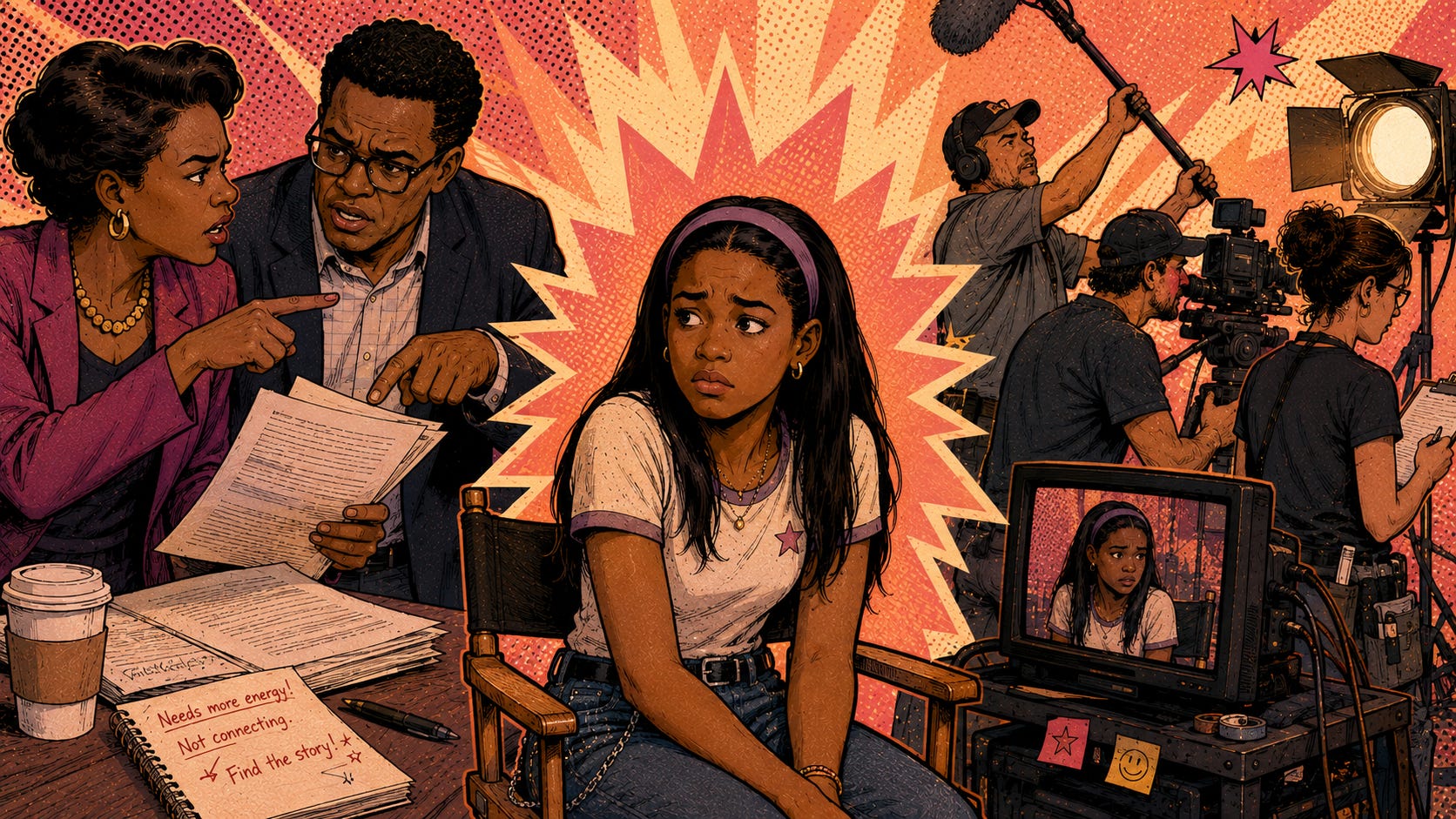
Last week, former child actress Raquel Lee Bolleau filed a lawsuit against Disney alleging that, while filming the 2001 Disney Channel movie The Poof Point, she was repeatedly sexually abused by an adult male employee involved in the production. Bolleau was just 14 years old.
According to the lawsuit, the alleged abuse occurred in a hotel room, where Bolleau says the man supplied her with alcohol before assaulting her, and also in ways she says should have raised alarms on set. She alleges that he fondled her and rubbed his genitals against her while giving her unsolicited hugs “in plain view” of others working on the production. She also alleges that the guardian assigned to her was separated from her for much of the workday.
Then, according to Bolleau, her behavior changed. Her demeanor shifted and her performance suffered. Her lawsuit alleges that Disney noticed those changes but, rather than recognizing them as possible signs that something was happening to the child in its care, executives blamed and threatened Bolleau and her mother. Disney has not publicly responded to the substance of the allegations and the claims have not been adjudicated.
The contrast with that mother’s story from all those years ago is difficult to ignore. A mother notices her daughter’s behavior changing and wonders what is influencing her child. An institution allegedly notices a child’s behavior changing and wonders what is wrong with the child. Somewhere in that contrast is something I was circling when I first wrote about children’s entertainment two years ago. The issue isn’t simply whether television taught children to be disrespectful to their parents. It’s what happens when the relationships and authority children depend on to protect them are weakened, absent, or fail.
Who Was Supposed to Be the Grown-Up?
There is also an eerie irony in the movie at the center of Bolleau’s allegations. The Poof Point was itself built around the kind of parent-child reversal I wrote about in 2024. Bolleau played Marie, one of two teenagers embarrassed by and somewhat disconnected from their scientist parents. After a malfunctioning time machine begins “de-aging” the adults, Marie and her brother are left to manage them, fix the machine, and ultimately save them before they disappear altogether.
The movie ultimately uses the experience to bring the family closer together, but viewed alongside Bolleau’s allegations more than two decades later, the role reversal takes on an uncomfortable resonance. At 14, Bolleau was playing a girl forced to take on more responsibility because the adults around her could not function as adults, while according to her lawsuit, the actual adults around her were failing to protect her. The fictional adults became children and needed Marie to save them. The real child, Bolleau alleges, needed adults to act like adults.
That trope was hardly unique to The Poof Point. I grew up on All That, The Famous Jett Jackson, The Amanda Show, Kenan & Kel, That’s So Raven and the whole late-’90s and early-2000s ecosystem of children’s television, where adults were often clueless and kids more perceptive than the grown-ups around them. There is nothing inherently sinister about children enjoying stories in which they outsmart adults. But Quiet on Set exposed a contradiction I hadn’t fully considered: while children’s television was making a joke of adult authority, the actual children producing that entertainment were deeply dependent on adults to protect them.
On television, incompetent adults were funny because the children could always save the day. Off camera, children needed the adults to be competent because the consequences of their failure were real.
Quiet on Set made that contradiction considerably harder to ignore. Drake Bell revealed that he had been sexually abused as a teenager by dialogue coach Brian Peck, who was later convicted of sexually abusing a minor, while other former Nickelodeon performers described inappropriate material and troubling working environments. Bolleau herself appeared in the documentary, speaking about her experiences as a young Black actress on The Amanda Show, though not about the allegations she is making now. She later said hearing Bell disclose his abuse had been retraumatizing for her.
That makes her lawsuit especially haunting because Bolleau isn’t just another former child star coming forward in the wake of Quiet on Set. She is one of the children we were watching. While we sat at home watching kids perform the carefree, mischievous childhood being sold to us, some of those children now say their own childhoods were being profoundly violated behind the camera.
Children Need Adults
There is a strange lesson we sometimes give children about growing up: that maturity means needing adults less. Eventually, of course, that is true. Childhood is supposed to prepare people for independence. But a 14-year-old is still a child and children need adults whose loyalty is actually to them.
An employer’s first concern may be getting the production finished. A network wants a successful show. A director needs the performance. A studio has schedules, contracts, budgets, and reputations at stake. A parent looking at her daughter and thinking, something is different about my child, has a fundamentally different interest.
Parents are not infallible and some fail their children terribly; but healthy parental attachment remains one of the most important protective relationships children have. A child who knows that Mom is going to ask where she was, who she was with, why that adult keeps texting her, or why her personality suddenly seems different isn’t merely being “controlled”; she is being watched over.
Now that I’m a mother myself, that lands differently than it did when I first encountered that blogger’s story all those years ago. Back then, what stood out was that she wouldn’t allow her daughter to disrespect her. Now what stands out is that she noticed. She knew what was normal for her child well enough to recognize when something wasn’t.
Safeguarding children is often that mundane: asking questions, knowing the adults around them, paying attention when their personalities change, and maintaining boundaries even when they think they’re unfair. That kind of attentiveness can easily be recast as overbearing, but the embarrassing mom asking too many questions isn’t necessarily the obstacle to the adventure, nor is the dad who wants to know where you’re going an idiot. Sometimes those are exactly the adults a child needs.
There is something haunting about The Poof Point in retrospect. Beneath all its silliness, it is ultimately a story about repairing the relationship between children and their parents. Yet Bolleau now alleges that while helping tell that story at 14 years old, she was being sexually abused in an environment where the adults responsible for her welfare failed to protect her. A movie in which children save adults was being made around a real child who, according to her lawsuit, needed saving herself.
Two years ago, I ended my essay by arguing that we should critically examine what children’s entertainment teaches young people about family relationships. I still believe that, but I would put it differently now. The lesson of Quiet on Set was never that children need fewer adults telling them what to do, and the lesson of Raquel Lee Bolleau’s allegations isn’t that children should learn to distrust grown-ups. Children are already vulnerable precisely because they have to trust adults.
The question is which adults we permit access to them and whether the people who genuinely love them remain close enough to recognize when something has gone wrong. Children don’t need a world without adult authority; they need adults worthy of it. And when they don’t have them, the adults are the problem.
One of the places you see this is teachers attempting to deal with students who have issues parents never dealt with in the home , and they are expected to “fix” kids who show up broken . Whether that's the result of “gentle parenting” , or not being engaged, or an inability to say “no” and set boundaries , teachers are now expected to take on far more than education. This really goes to what is happening in families.
Agree completely Kristin. "the adults are the problem." I'm a boomer woman, no children. Yet believe humans are a product of their environment and parents have one of the most important responsibilities for humanity. This has always been true and is even more so now with the deluge of external influences that did not exist before the internet and exacerbated by social media. I value your insight into 90s TV programming "for kids", gave me new awareness from someone who lived it.