


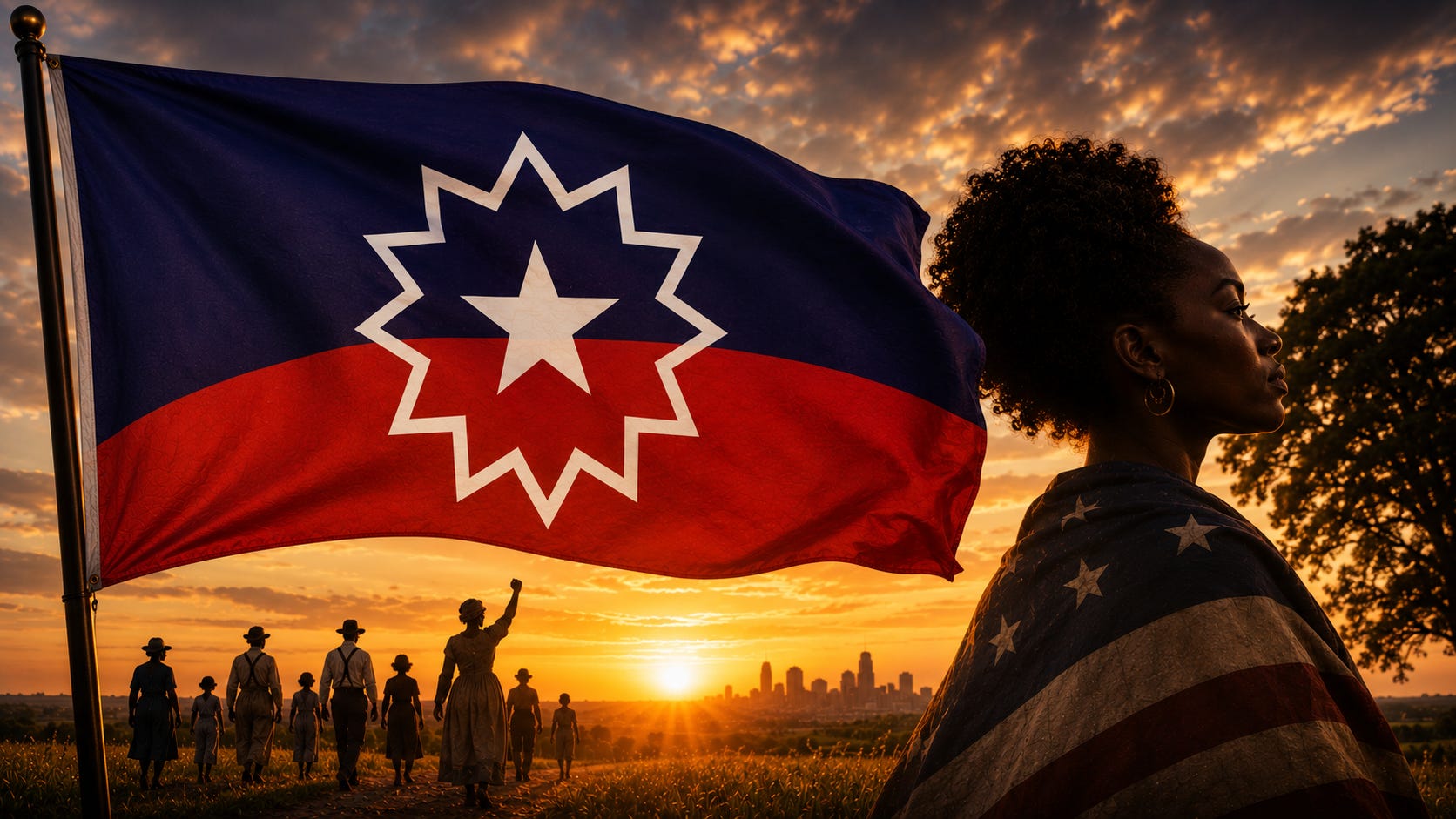
Every year, as Juneteenth approaches, social media fills with event flyers, business promotions, and celebratory graphics. Increasingly, those graphics share a common feature: red, black, and green. The Pan-African flag has become so ubiquitous in Juneteenth marketing that one could easily assume it is the official flag of the holiday itself.
It is not.
This may seem like a minor issue of aesthetics, but symbols carry meaning. Flags tell us who a celebration belongs to, what history it commemorates, and what story future generations are being invited to remember. When a distinctly Black American holiday is consistently represented through Pan-African imagery, the meaning of the holiday subtly changes. A commemoration of Black American emancipation becomes a generic celebration of the Black diaspora, and in the process, the people whose ancestors actually lived this history become less visible within their own story.
Juneteenth is not a Pan-African holiday. It is a Black American holiday.
That distinction matters because Juneteenth commemorates a specific historical event involving a specific people in a specific country. On June 19, 1865, Union troops arrived in Galveston, Texas, and announced that enslaved people there were free, more than two years after the Emancipation Proclamation had been issued. The day became a celebration of delayed freedom finally reaching those who had been denied it.
Texas, however, was not unique in having its own emancipation date. Florida commemorates May 20 as Emancipation Day because Union forces announced and enforced emancipation there nearly a month before Galveston. Floridians learned of freedom on May 20, 1865, and have celebrated “May Day” or “The Twentieth of May” ever since.
Both days are part of the story of millions of Black Americans whose ancestors endured slavery in this country and lived to see freedom finally arrive. These commemorations are not celebrations of the Black diaspora in general, nor are they generic observances of Blackness. They are markers on the journey of a particular people from bondage to freedom.
That specificity is precisely why the colors of Juneteenth matter.
The official Juneteenth flag was created in 1997 by activist Ben Haith, known as “Boston Ben.” He deliberately chose red, white, and blue. The colors were not selected accidentally, nor were they chosen to imitate the American flag. They were chosen because, in Haith’s words, “Our ancestors made this country great.”
That statement reflects a profound truth about Black American history. Our ancestors built wealth they could not keep, cultivated land they did not own, and contributed immeasurably to the economic and political development of the United States while being denied the rights and privileges of citizenship. Juneteenth commemorates not only emancipation but also the long struggle to claim a birthright that should never have been denied in the first place.
The holiday is fundamentally about freedom and citizenship. Juneteenth marks the moment emancipation finally reached the last large population of enslaved Black Americans still held in bondage in the former Confederacy.. It is the story of a people who were denied the promises of this nation and then fought to claim them. In many ways, Juneteenth is one of the most distinctly patriotic observances in Black American life because it celebrates a people finally being permitted to claim the promises of a country they had already spent centuries building.
The late Opal Lee, known as the “Grandmother of Juneteenth,” spent decades fighting for national recognition of the holiday because she believed the story of emancipation belonged within the American story itself. Her advocacy reflected the belief that Juneteenth commemorates both freedom and citizenship—the moment when a people long denied the promises of the nation began claiming them as their own.
That is why the red, white, and blue of the Juneteenth flag is so important. It symbolizes that Black Americans are not merely a diaspora population living in the United States. We are an American people. Our ancestry on this continent often stretch back centuries, frequently further than those of many later-arriving immigrant groups. Millions of Black Americans can trace their roots in North America to periods before the large waves of Irish, Italian, and Eastern European immigration that reshaped the country’s demographics in the nineteenth and early twentieth centuries.
Our American-ness is not borrowed. It is ancestral.
Yet there remains a curious discomfort with this idea. Black Americans are often encouraged to reject the red, white, and blue because those colors are associated with America itself, as though there is something contradictory about being proudly Black and proudly American at the same time. No one expects Haitians to reject their flag because it shares its colors with France’s flag. No one suggests that Irish Americans abandon their symbols because another nation uses similar colors. Only Black Americans are routinely asked to distance ourselves from our own national inheritance.
The increasing use of Pan-African colors for Juneteenth reflects, in part, this discomfort. For some Black Americans, it may stem from a kind of national insecurity or low national self-esteem—a reluctance to embrace our identity as an American people because we have been taught that patriotism belongs to everyone except us. But for others, particularly those outside the Black American experience, there is sometimes an impulse to fold every Black history into a single global narrative.
I have increasingly come to think of this as a kind of destiny swapping.
A holiday commemorating the emancipation of Black Americans becomes recast as a celebration of the global Black diaspora. The particular becomes universal, and in that process, the descendants of enslaved Americans become an afterthought in our own story.
This tendency is especially striking given contemporary discussions surrounding reparations. Ghana’s Presidential Envoy for Reparations, Dr. Ekwow Spio-Garbrah, has been among those advocating for reparative justice concerning the transatlantic slave trade. Yet history also requires us to acknowledge the uncomfortable reality that various African kingdoms and merchants also participated in the capture and sale of human beings into that trade.
None of this diminishes the horrors of American slavery, nor does it absolve the United States of its responsibilities; but it does make it particularly strange to watch a distinctly Black American emancipation holiday become symbolically detached from Black Americans themselves and reframed under banners representing movements and identities that played no role in the emancipation of enslaved people in the United States.
This year I noticed another irony. The University of South Carolina, a predominantly white institution in my home-state, used the correct colors in its Juneteenth graphics. Clark Atlanta University, a historically Black institution in the state that I now call home, did not.
Perhaps some will dismiss this as a trivial matter of design. I do not think it is trivial at all. Symbols teach. They shape memory. If future generations come to believe that Juneteenth is simply another celebration of the global Black diaspora, then something important will have been lost.
Juneteenth is not a celebration of everywhere. It is a celebration of here. It commemorates the moment when millions of Black Americans emerged from slavery and began the long work of staking their claim to the full rights of citizenship in the nation their ancestors helped build. The Juneteenth flag is red, white, and blue because our ancestors made this country great too. Its symbols should reflect that reality.
That story deserves to remain intact.
Brilliantly said! 💯❤️
Restacking this piece because it’s just too good not to…. 👏👏