


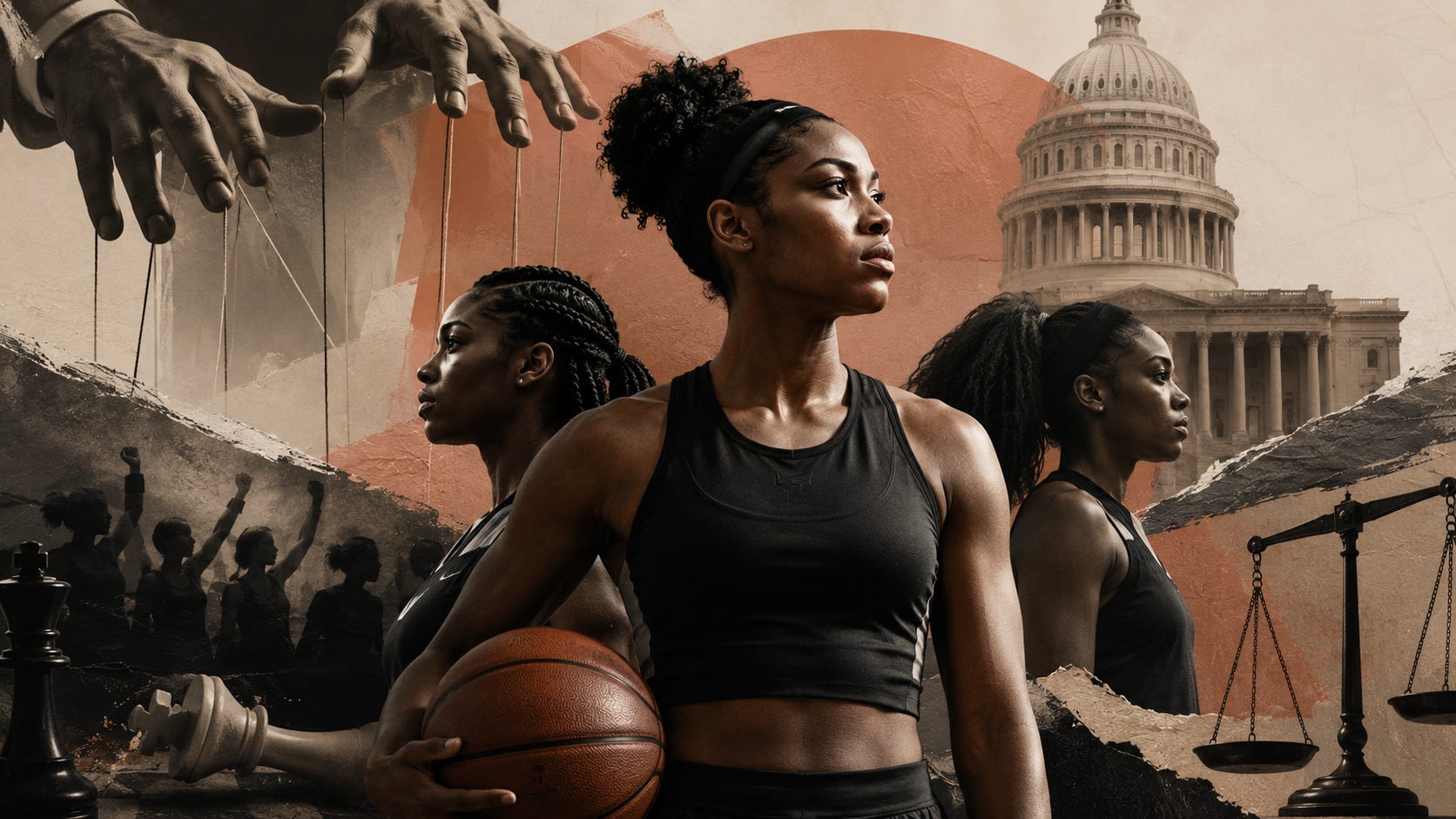
There is a pattern that has become difficult to ignore. A political shift occurs, the language escalates, and almost immediately the burden moves—not upward toward the institutions that claimed authority, but downward toward those with the least capacity to absorb loss.
This time, it is young Black athletes being asked to carry it.
The NAACP’s “Out of Bounds” campaign presents its call as a moral imperative: withhold talent, withhold participation, withhold economic contribution from states accused of weakening Black voting representation. The framing is urgent. But beneath that urgency sits a simpler question: who is being asked to sacrifice—and why is that burden being directed downward?
Leaders who have spent decades inside political and nonprofit institutions are now turning to 18- and 19-year-olds and framing sacrifice as obligation—despite the fact that the cost is not symbolic. Scholarships, NIL opportunities, draft positioning, long-term earning potential—these are the mechanisms through which many young athletes secure stability, not just for themselves, but for their families.
What makes this moment difficult to ignore is that the institutions now calling for sacrifice have not shown the same urgency when it comes to protecting the material interests of those they are addressing.
Recent federal proposals around college athletics, including legislation supported by members of the Congressional Black Caucus, have included provisions that would limit athletes’ ability to challenge compensation structures, restrict pathways to employee status, and override stronger state-level NIL protections. These are not abstract policy questions. They go directly to the economic leverage of the same young athletes now being asked to withhold opportunity for the sake of political pressure.
Constraints on athlete compensation and labor rights were treated as negotiable policy matters. But when institutional political power is perceived to be at risk, the language shifts immediately to urgency, crisis, and moral obligation.
To ask young athletes to risk that path in service of a political outcome that older generations have struggled to achieve over decades is not empowerment, but transfer of responsibility.
And it is not an isolated one.
Increasingly, modern activist politics operates through a downward transfer of burden. Institutions retain authority and insulation, while the cost of moral action is shifted onto those who are younger, more emotionally invested, and more materially vulnerable. Women are asked to absorb instability in the name of inclusion. Students are elevated as the moral face of movements they did not design. Young athletes are asked to leverage—and potentially jeopardize—their futures. The logic is consistent: those with the least protection are asked to carry the greatest weight.
This dynamic appears even in spaces explicitly designed to preserve group-specific experiences. A long-sought Smithsonian American Women’s History Museum—intended to materially establish a national institution dedicated to women’s history—collapsed after disputes over ideological framing, including whether the definition of “women” itself should be contested within the museum’s scope. The result was not an expanded outcome, but no outcome at all. Women were left without the institution, while the broader conflict remained intact.
Radical feminism has long named this dynamic. Women are expected to stabilize systems they did not create, to absorb conflict quietly, to subordinate their own interests for institutional harmony. What is happening here is not separate from that pattern—it is an extension of it. The expectation is not just participation, but moral labor on behalf of institutions that remain largely unaccountable.
For more than half a century, Black political loyalty has been treated as both expected and sufficient. The community has been mobilized, organized, and reliably turned out in moments framed as urgent or existential. Yet when those moments pass and outcomes are measured materially, the results remain uneven. Underperforming schools, limited economic mobility, uneven healthcare access, and persistent neighborhood instability are not new problems. They are enduring ones.
That absence of results is reinforced by how political urgency is constructed. The history of Black disenfranchisement is real. But that history is increasingly used to collapse distinctions that matter. Any shift that weakens Democratic political advantage is framed as a racial crisis. Partisan loss becomes existential threat. And once that shift is made, the expectation of sacrifice becomes easier to justify.
There is also an assumption doing quiet work here—that the athletes being addressed are politically aligned, that they share the same priorities, and that they should subordinate personal opportunity to a strategy they did not shape. That assumption removes the need for persuasion. But real political engagement requires making a case—and demonstrating that what is being asked will produce tangible outcomes.
What is offered instead is largely symbolic. Boycotts generate attention. Campaigns create visibility. But the costs are not symbolic. A declined scholarship is a lost opportunity. A disrupted athletic trajectory is a material consequence. It is easy to call for sacrifice when the cost is externalized. It is harder when those making the call remain insulated from its effects.
The issue is not whether political power matters…it does. The issue is where responsibility is being directed. If organizations and leaders claim to represent Black interests, then accountability should follow. What was promised? What was delivered? What changed?
Those are harder questions than asking young people to take a stand. But they are more necessary ones.
Because real political power is not measured by how much a community is willing to sacrifice. It is measured by what that community can demand—and receive in return. A group that is consistently asked to give—time, loyalty, opportunity—without clear material return is not being empowered. It is being managed.
There is a difference between collective action that builds power and demands that redistribute loss. Young Black athletes are being asked to make decisions that could shape their lives. That deserves more than urgency. It deserves clarity, honesty, and accountability from those making the ask.
Because if the strategy requires the youngest and least insulated to carry the greatest burden, then the question is not whether they should comply.
It is why that burden keeps being placed on them at all.
"It is harder when those making the call remain insulated from its effects."
So much wisdom throughout your Peachy Perspective. This line really stood out.
They are designated to be the sacrificial pawns in someone else's game plan. Why not ask all athletes to sacrifice themselves for the cause? And if they say “no” will they be seen as traitors? NAACP should have at least given the appearance of having brought student athletes into the discussion before issuing this dictate ; which of course was never even a consideration. This will not play well and will accomplish nothing.