


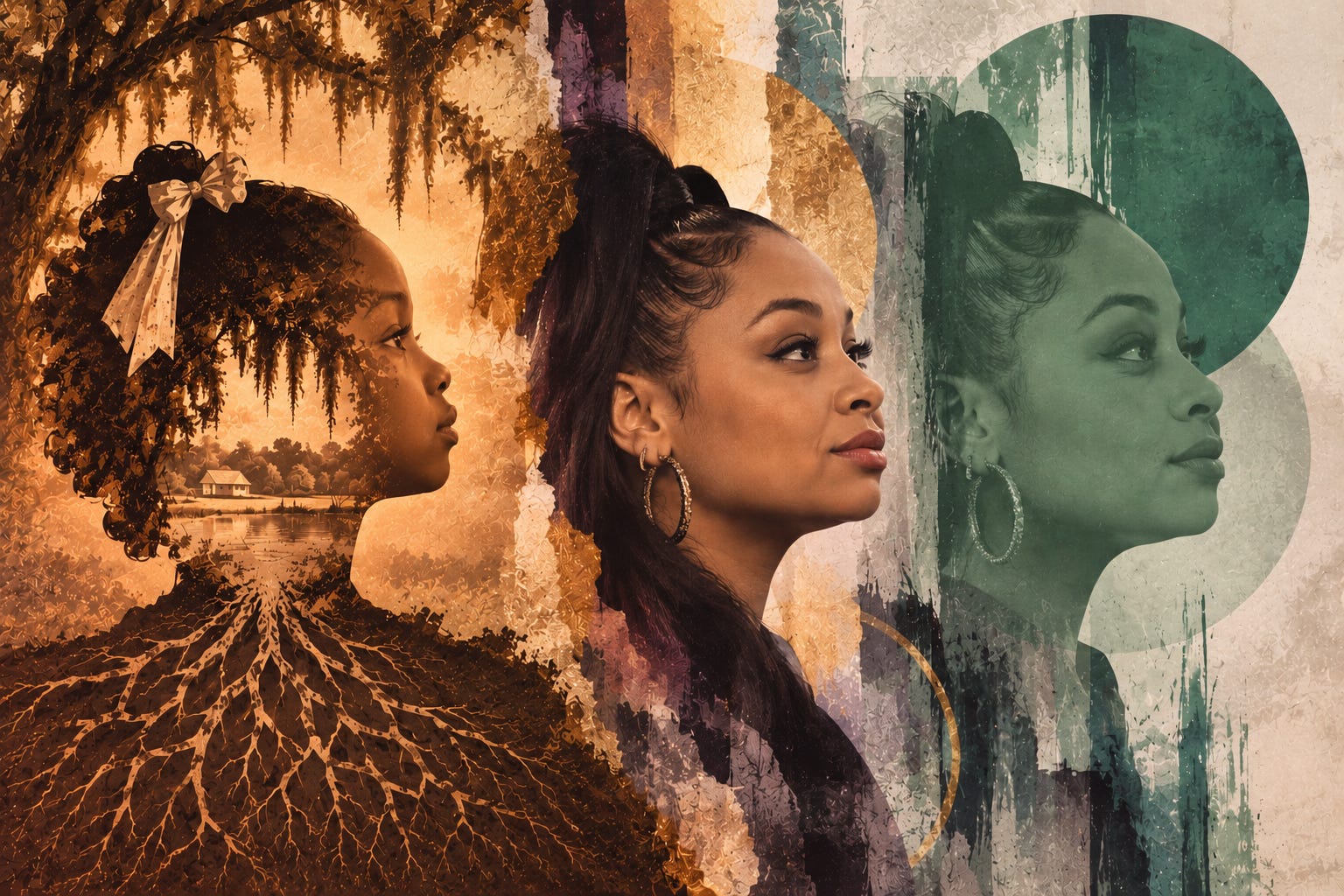
Long before Raven-Symoné asked us to imagine Raven Baxter as green, she played a little girl for whom color could never be incidental. In 1993, a six-year-old Raven appeared in Alex Haley’s Queen, the television adaptation of Haley’s novel about his paternal grandmother. Queen was born enslaved in Alabama, the daughter of an enslaved Black woman and the white son of a plantation owner. Fair-skinned enough that she could sometimes pass for white, Queen nevertheless discovered that she could not simply choose herself out of the racial world into which she had been born. Her racial ambiguity did not make race irrelevant…it made race inescapable.
Thirty-three years later, Raven is asking a very different question about another character she played. During an April episode of Tea Time with Raven & Miranda that recently went viral, actor and comedian Kalen Allen described Raven Baxter, the title character of Disney Channel’s That’s So Raven, as unmistakably Black. Raven interrupted: “Was she Black?” When Allen explained that he saw the Baxters as a Black family, Raven pushed the thought experiment further. Take away their color, make them green, and listen to the words. What color would they be then?
Allen has since explained that the project existed in an earlier form before Raven was attached and that he understood her to be talking partly about the character as originally conceived. Raven Baxter did not necessarily have to be Black before Raven-Symoné became Raven Baxter. Allen nevertheless maintains that the character audiences actually received was undeniably a Black girl living in a Black family on a show that sometimes addressed anti-Black discrimination explicitly.
That context makes Raven’s comment more understandable, but it does not make it less interesting, particularly because this is not the first time she has seemed uncomfortable with the significance other people attach to her Blackness. In a now-infamous 2014 interview with Oprah Winfrey, Raven resisted two labels at once. She did not want to be called gay, despite acknowledging that she was in a relationship with a woman; she wanted to be understood as “a human who loves humans.” Then came the comment that startled Oprah: Raven did not want to be called African American either. She was American.
Her explanation was more thoughtful than the controversy sometimes allowed. Raven said she did not know which African country her ancestors came from but she knew her roots were in Louisiana. She has since clarified that she never meant she was not Black and, truthfully, I find part of her argument compelling. A Black American whose family has been in Louisiana for generations does have a history distinct from someone who recently immigrated from an African country. Louisiana is not evidence that Raven lacks roots because she can not identify an African nation. Louisiana is part of her roots. Black Americans descended from the people who lived through slavery and segregation here and developed our own history and cultural memory here.
That actually makes Raven’s more recent impulse to make Raven Baxter green more strange to me, not less.
Her years on The View produced several other controversies involving race: questioning whether a comparison between Michelle Obama and a Planet of the Apes character was necessarily racist, preferring Rosa Parks to Harriet Tubman for the $20 bill, and infamously saying she would discriminate against an applicant with a name like “Watermelondrea,” for which she later apologized. Any one of those could be dismissed as a celebrity putting her foot in her mouth; however, taken together with the Oprah interview and her recent comments, they suggest something more interesting. Raven does not deny being Black but she seems resistant to the idea that Blackness should mean very much about her unless she decides that it does.
I actually understand part of that impulse. I am a Southern-born Black American myself, and Black American is the term I prefer to African American, and have little patience for the idea that my Blackness comes with an ideological instruction manual. I do not believe my race determines my politics, the causes I must support, the people I must vote for, or the conclusions I am permitted to reach. I am socially and politically Independent in part because I resent the assumption that anyone else gets to decide those things for me…but there is a difference between independence and disconnection.
That is why it interests me that Raven rejected “gay” and “African American” in essentially the same breath. Her answer was remarkably consistent: do not put me in your categories. I am a human who loves humans. I am an American. Seen together, those statements sound less like unrelated opinions about sexuality and race than a philosophy of identity: the categories other people perceive when they look at Raven should not determine the meaning of Raven.
There is something attractive about that kind of individualism but also something incomplete, because some identities are not merely labels we place on ourselves…they are inheritances. Raven did not have to identify as a descendant of the Black South for her Louisiana ancestors to have lived their lives there and Raven Baxter did not need to announce her Blackness every week for Black children watching Disney Channel to recognize something meaningful in seeing a Black teenage girl with a unique sense of style at the center of a successful show. Make the Baxters green if you like…the audience that encountered them was not.
I also wonder whether Raven’s sexuality helps explain why such individualism might be especially appealing, without suggesting that lesbianism somehow produces racial disconnection. For many Black children growing up, Blackness is not necessarily what initially makes us feel different. Blackness is home: our parents and grandparents, church, neighbors, food, language and history. For a lesbian, bisexual, or gay child in that environment, homosexuality may instead become the characteristic that marks difference within that belonging.
The identity you inherited may give you a community in which you belong while the sexuality you discover makes you different within it. Adulthood can then offer another community in which that difference becomes a basis for belonging. For someone who entered entertainment extraordinarily young and eventually moved through cosmopolitan celebrity circles, the distance between the world that formed her and the worlds in which she later found acceptance could become enormous.
I can not know how much of that explains Raven, nor do I think her biography proves some universal rule about Black lesbians, but it makes me wonder what happens when the community into which you were born communicates that something essential about you is to be hidden while another community tells you that same thing is worthy of celebration. What happens when leaving home feels like freedom…and what happens to your understanding of home after decades away?
Black American identity, particularly in the South, has historically been intensely communal: family, church, neighborhood…shared institutions and shared history. Modern gay and lesbian identity, by contrast, is often narrated through individual discovery: realizing who I am, refusing other people’s expectations, coming out, finding my people, living authentically. Those ways of understanding identity do not have to conflict, but Raven’s comments raise an interesting question about what happens when the individualist framework used to reject expectations imposed upon sexuality gets applied to an inheritance that exists whether or not we choose to emphasize it.
Perhaps that is why Alex Haley keeps nagging at me as I think about Raven. Haley’s work was obsessed with roots. He looked backward—toward ancestors, geography, slavery, family and inherited memory—to understand the people standing in the present. Raven-Symoné began her career portraying a child in one of those stories. Little Queen could not make herself green. Her appearance sometimes allowed other people to imagine her as belonging to one racial world or another, but neither her appearance nor her wishes could erase the history that made her who she was.
There is something strange about watching a descendant of the Black South discover a version of colorblindness after generations of her ancestors survived a country that never afforded them the same privilege, but the lesson is not that Black people should remain inside some prescribed racial lane. Blackness does not require political conformity, romantic segregation, living in the South forever, sharing our grandparents’ religion, or making every decision according to what other Black people expect of us.
Roots are not chains. They are the history beneath whatever direction we choose to grow.
That is ultimately what bothers me about asking whether Raven Baxter was really Black. Millions of Black children did not need an announcement to recognize her. Blackness was present not merely in Raven Baxter’s complexion but in her family, experiences, cultural context, and in the significance of a Black girl occupying that much space on the Disney Channel. The audience was not imagining something that was not there.
Perhaps that is the limit of radical individualism: we are not the sole authors of what we mean. We inherit things we did not choose, even as we should remain free to reject the expectations attached to them. Raven can call herself American rather than African American. She can refuse to let being Black or lesbian dictate her politics, relationships or the life she builds. None of that requires pretending the inheritance itself disappears.
Raven-Symoné has traveled a long way from the six-year-old girl who played Alex Haley’s Queen. In many respects, that is the American success story. We can refuse the politics people assign us, love people they never expected us to love, build lives almost unimaginably different from those available to the generations before us, and travel as far from other people’s expectations as our freedom allows.
Roots are not supposed to keep us from growing, but however far the branches reach, they still tell us something about where the tree came from.
Raven can leave the Black South…she just can not make it green.