


Six days after giving birth, with a spinal headache that outpaced every other kind of pain, I finally opened my laptop.
My daughter was asleep. I was finally feeling well enough for me to think, maybe I can do this now. Before she was born, I had imagined something very different—writing in the hospital, or in those early quiet days at home. I even had my husband bring my laptop back from the house on his first trip to check on the pets, as if I would be casually drafting essays between newborn snuggles. In hindsight, naïve doesn’t begin to cover it.
I did not touch my computer until six days later. And even then, it was not because things had settled. It was because something in me could no longer hold the words. For months, I had known what I wanted to write. The idea sat with me through pregnancy—forming, sharpening, waiting—but I was unsure where it belonged.
I had written about gender ideology before: how I came to see its harms after once supporting it; the patterns among young women attempting to escape womanhood after trauma, abuse, or alienation; the pressures placed on mothers; the quiet encroachment into women’s spaces. But this piece resisted that frame. It was not analysis or critique. It was not something to be written from a distance.
This time, I wanted to write from the body—through pregnancy, through birth, through the clarity that comes when abstraction collapses into lived reality. Holding my daughter made something even more unmistakable. Arguments about “womanhood,” once theoretical, had become immediate, material, undeniable.
Months earlier, I had come across the call for She Holds The Line: Black Women Speak on Gender Ideology. It invited Black women to share personal accounts of how gender ideology had shaped our lives—naming, directly, what so many of us are discouraged from saying: silencing, backlash, male intrusion into female spaces, and the weaponization of Black womanhood. I read it once, then again, and the answer came quickly. This was where the piece belonged.
By the time I finally opened my laptop, the essay had been living in me for months. When it came, it did not arrive slowly. It moved. I wrote through the pain, aware that the moment had come and that the words had already waited long enough. The next day, I would end up in the emergency room twice and end up staying overnight for observation. But by then, the piece was finished.
And what it gave shape to was something I had been circling throughout my pregnancy, but could only fully grasp after becoming a mother.
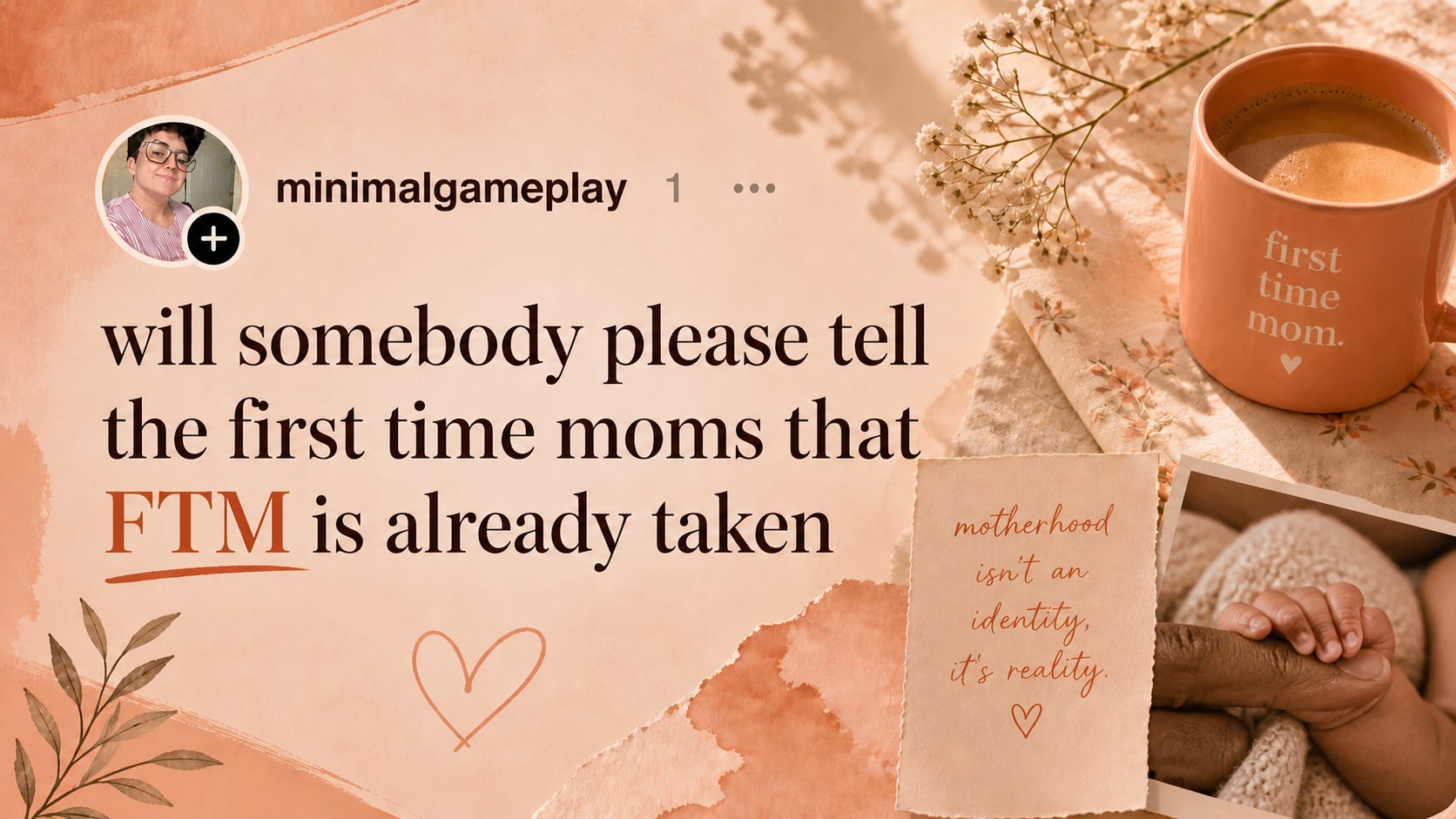
Somewhere along the way, the meaning of “FTM” was displaced. It never ceased to mean first-time mom, but it ceased to be heard that way. My essay, “The Real FTM: Holding the Line as a Black Mother in a World That Erases Women,” is an attempt to recover that meaning—through pregnancy, birth, and the reality of becoming a mother in a culture that increasingly treats womanhood as something to be redefined rather than recognized.
It is, at its core, about the tension between lived experience and ideological language: carrying life while being told that motherhood is merely an identity; becoming a mother while watching the concept itself loosen from its material grounding; holding a daughter and recognizing, with a clarity that resists reinterpretation, that some truths do not bend.
This is one part of why the anthology matters.
As Nevline Nnaji, the editor, describes it, She Holds The Line is “a groundbreaking anthology” examining the impact of the transgender movement on the lives of Black women. It brings together thirteen contributors—mothers, artists, lesbians, bisexual women, detransitioners—whose accounts reflect both personal cost and broader social consequence. Many of us have faced backlash for speaking plainly. Taken together, our stories “shatter common stereotypes” about who holds dissenting views, and why.
But the marginalization our voices address is not confined to one arena. Black women have often had to navigate this conversation without a stable place to land—discouraged from speaking plainly in mainstream spaces, and not always fully recognized within gender-critical ones. Not out of malice, but out of a gap in attention and understanding. Yet the realities we face, shaped by both sex and race, are not peripheral to this issue. They are central to it.
This is part of what She Holds The Line offers: not simply a platform, but a correction. It situates Black women’s voices where they belong—not as supplementary, but as integral to any serious understanding of the present moment.
When I first began advocating for women’s sex-based rights, I often framed it in terms of a future daughter. Now she is here. And the work looks different. It looks like writing when it is necessary, even when it is difficult—six days postpartum, in pain, in a body still catching up to what has just occurred. It looks like refusing to wait for ideal conditions to say what needs to be said.
Because the line does not hold itself. It is held.
My essay appears in She Holds The Line: Black Women Speak on Gender Ideology, now available for purchase. For those familiar with my work, the themes will be recognizable. But the vantage point is not the same. This piece is more personal, more grounded—written from the other side of something I had previously only approached in theory.
And for those concerned with where this conversation is going—particularly for Black women, and for the girls who will inherit its consequences—the anthology offers something rare: not consensus, but clarity; not abstraction, but lived experience; not distance, but proximity to what is at stake.
We are still here and we are still holding the line.
#SheToo has rights!
Congratulations! Mother for Mother’s Day! Your daughter is blessed to have you!! Praying for your thoughts, all your crucial work! May God bless you!!