


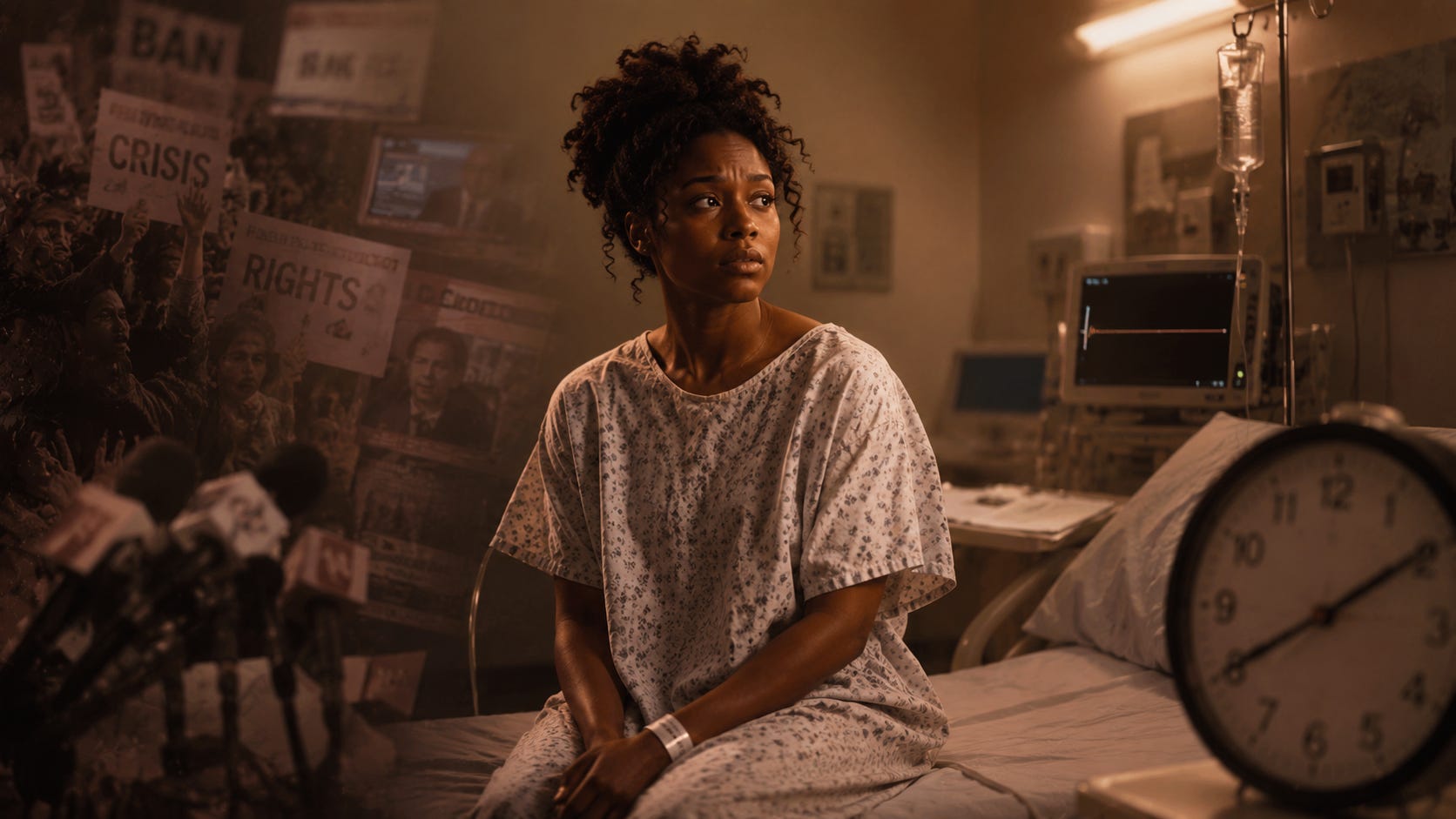
By now, the pattern is familiar. A woman dies under tragic circumstances, and before the details have fully settled, the cause is declared: an “abortion ban.” The story arrives pre-packaged, emotionally charged, and politically useful. It travels quickly because it feels clear. It offers a villain. It offers urgency. And it offers a ready-made conclusion. But clarity is not the same thing as truth.
The death of Amber Nicole Thurman has once again been pulled into this narrative. Her mother, Shanette Williams, is speaking publicly about her loss and urging voters to see her daughter’s story as evidence of a system that failed women. The grief is real, and it is devastating. A young mother is gone. A child will grow up without her. Nothing about that should be minimized.
What deserves scrutiny, however, is not the grief itself—but what is being built on top of it.
Georgia law explicitly permits abortion procedures in cases of “medical emergency,” defined as necessary to prevent the death of the pregnant woman or “substantial and irreversible physical impairment of a major bodily function.” In response to confusion surrounding high-profile Georgia cases, Attorney General Chris Carr also stated publicly that “there is nothing in the LIFE Act” requiring doctors to withhold necessary treatment or maintain life support in situations unrelated to intentionally terminating a pregnancy.
The barrier was time.
According to reporting, doctors delayed performing a routine, life-saving procedure. Not because it was explicitly forbidden, but because of hesitation, confusion, or misinterpretation. And in medicine, hesitation can be fatal. When care is delayed in a situation that requires urgency, the outcome is no longer a matter of policy—it is a matter of practice.
That distinction keeps disappearing.
This is not an isolated framing error. It is a pattern. In an earlier piece, I wrote about how Thurman’s case was initially presented as proof of a system that denies care, even as evidence pointed toward a failure to deliver care in time. The same narrative arc has re-emerged, now with greater political force, as her story is folded into campaign messaging and electoral strategy.
We saw a nearly identical dynamic unfold in the coverage of Adriana Smith. When Smith, a pregnant nurse, was declared brain-dead, the media quickly attributed her prolonged life support to Georgia’s LIFE Act. That claim was repeated widely—and incorrectly. The law governing her situation was the Georgia Advance Directive for Health Care Act of 2007, a statute predating Dobbs and the current abortion debate.
That legal distinction mattered. It explained why doctors were required to continue life-sustaining treatment in the absence of an advance directive. It clarified that this was not a case of abortion law overriding medical judgment, but of an existing framework determining default care. Yet that explanation never carried the same weight as the initial claim. It was less useful, less provocative, and far less politically convenient.
More importantly, it redirected attention away from another uncomfortable truth: Adriana Smith sought care before her collapse and was sent home without critical testing. Her symptoms—severe headaches—were not treated with the urgency they required. A CT scan was not performed. By the time the full extent of her condition was discovered, it was too late.
Once again, the failure was medical…but that is not the story that traveled.
What followed instead was a broader cultural argument about whether her continued life support represented compassion or cruelty. The debate centered on autonomy, on law, on ideology. Meanwhile, the question of why her condition was not properly diagnosed at the outset faded into the background.
That omission is not neutral. It shapes what the public understands as the problem—and therefore what they demand as a solution.
There is another part of Smith’s story that complicates the narrative further, and it is one that has been far more difficult to incorporate. Her son, Chance, survived. Born extremely premature, he spent months in the hospital before finally going home. By recent accounts, he is growing, gaining weight, and described by his family as a happy, pleasant baby now reunited with his older brother.
He is here.
And his presence exposes something that much of the coverage has tried to avoid. Because it is difficult to maintain that this was purely a story of harm when there is a living child whose life was made possible by the very outcome being condemned. It is even more difficult to reconcile the intensity of the outrage with the fact that his own family expressed a clear desire for him to survive—that they wanted Adriana’s life to continue through her children.
That reality did not fit cleanly into the narrative. In some corners, it was met not with relief, but with hostility. The fact that a child survived was framed as an extension of the injustice rather than as something worth acknowledging on its own terms.
At a certain point, that response forces a harder question. If the survival of a wanted child is treated as a policy failure, what exactly is being defended?
Across these cases, the throughline is difficult to ignore. Women present with serious symptoms. Those symptoms are minimized, misread, or not acted on quickly enough. Care is delayed. The outcome becomes fatal or irreversible. And then, almost immediately, the cause is reassigned to a legal framework that did not, in fact, prohibit intervention.
This does more than misinform. It displaces accountability.
Because if the problem is understood as restrictive law, the solution becomes legislative change. But if the problem is delayed care—if it is hesitation, diagnostic failure, or institutional breakdown—then the solution lies elsewhere. It requires examining medical training, hospital protocols, risk tolerance, and the ways in which providers interpret legal boundaries in high-pressure situations. It requires asking why women, particularly Black women, continue to have their symptoms under-evaluated or dismissed until it is too late.
Those are harder conversations. They do not lend themselves to clean slogans or campaign messaging. They implicate systems that are less politically convenient to confront.
But they are also the conversations that might actually prevent the next death.
Shanette Williams wants her daughter’s death to matter. That desire is both understandable and justified. No parent should have to bury a child and then search for meaning in the aftermath. The question is whether the meaning being constructed reflects what actually happened, or whether it reflects what is most useful to those amplifying the story.
Because if we continue to use these deaths as evidence of care being denied, when the evidence points to care being delayed, we are not honoring these women. We are obscuring the conditions that led to their deaths. And obscured failures are repeated failures.
If there is any responsibility owed to women like Amber Thurman and Adriana Smith, it is this: to tell the truth about what failed them, even when that truth is less politically satisfying. It is not enough to demand access on paper if, in practice, women are left waiting for care that should have been immediate. It is not enough to invoke their names if doing so diverts attention away from the very systems that broke down when they needed them most.
The story they keep telling is simple, and that is why it spreads. But the story they won’t tell—the one about hesitation, confusion, and delayed care—is the one that might actually save lives.
Until that becomes the focus, nothing changes.
Thank you Kristen. Very brave and compelling piece. It’s so interesting when you contrast this narrative with the actions of the medical community and the narrative of “gender affirming care”. Even though the Trump Administration EO should effectively pause the medicalization and mutilation of children and minors as well as the indoctrination in schools, it really hasn’t. Most clinics, hospitals and schools (including many in red states) fight tooth and nail or as has been reported in some outlets ignore the EO entirely and continue to practice. They don’t seem hesitant or confused on that front.
Such an important distinction!
As for the “harder” conversation, though: it strikes me (watching safely from 🇨🇦) that the hospitals/systems in question *have* done risk assessments and the like, and have landed on “delay” as their safest option — that is, the legal landscape is so screwed up right now that they feel the risk is minimized by NOT taking the steps you have outlined.
I’m not suggesting that this is *ethical* - it kicks the moral hazard** down to staff, and of course fails the patient(s). But it may be *rational* given the lack of alternatives & the threats from GOP governments who’ve rendered themselves small enough to fit in any vagina that they have chosen to regulate 🤬
** Full disclosure: I’m a person who has been let down several times by my employers’ legal counsel, and borne similar moral hazard burdens.
It can be soul crushing fighting both against a system & for the right outcome 😢