


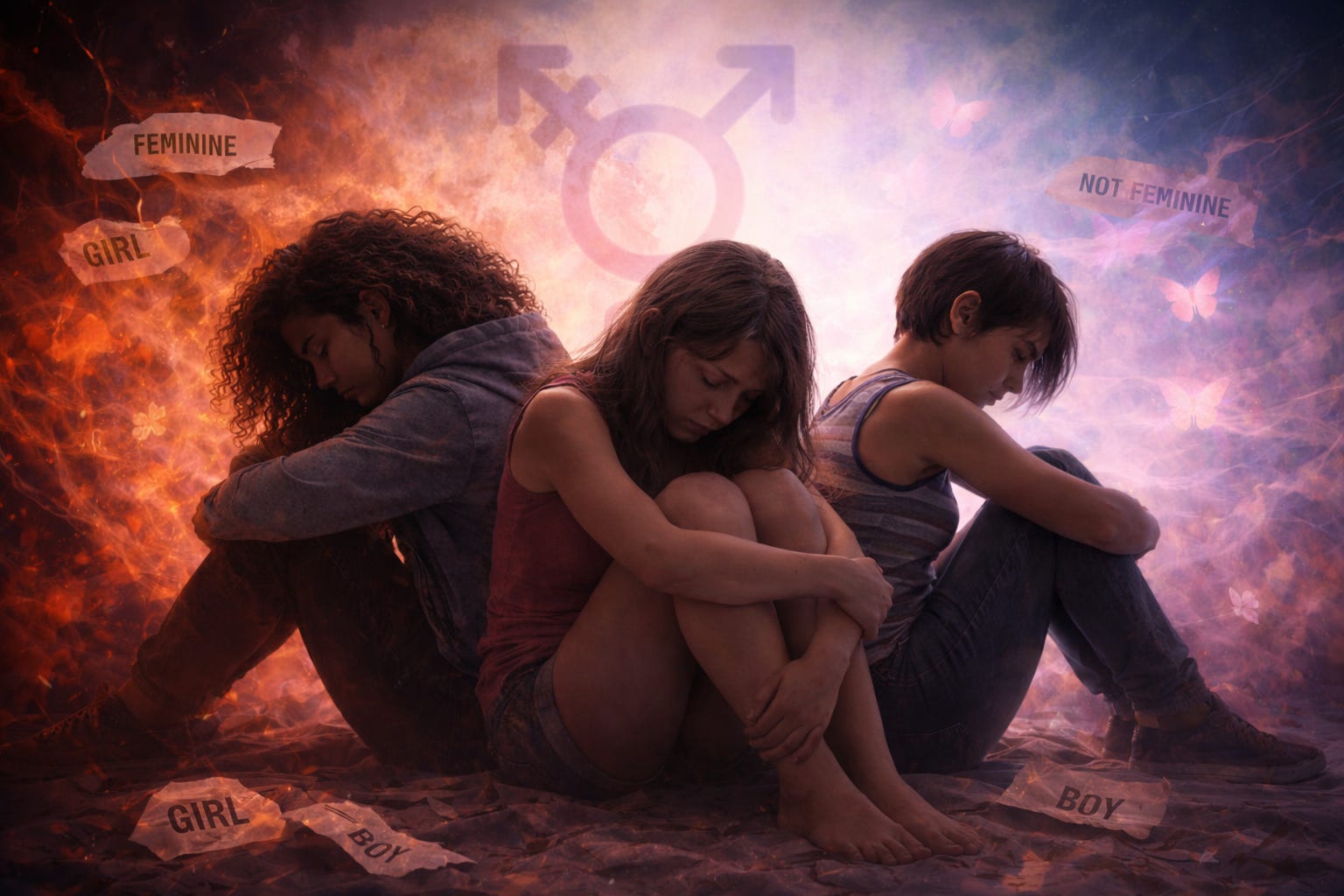
A quiet crisis has been unfolding for years, largely unnoticed because it masquerades as progress. In progressive youth culture, femininity has increasingly ceased to be a neutral set of tastes or dispositions. It has become a moral liability—something that must be justified, muted, or politically disavowed. And for some girls, the most reliable way to escape that liability has not been to defend womanhood, but to exit it.
We are told that gender ideology frees girls from stereotypes — a claim that has circulated for years. But what I see, again and again, is something far more paradoxical: girls who come to believe that enjoying femininity—especially unapologetic femininity—makes them politically suspect. Loving glamour, camp, excess, softness, or beauty is treated not as harmless preference but as evidence of shallowness or complicity. To remain acceptable, enlightened, and “woke,” they do not say, “I am a girl who loves femininity.” They say, “I am not a girl at all.” When femininity is framed as embarrassing or regressive, girls learn that the only way to enjoy it freely is to disown the category it is supposedly attached to.
This did not emerge spontaneously; it has been taking shape over years of cultural reinforcement. In activist spaces, online discourse, youth culture, and even parts of feminist theory, femininity has been recoded as evidence of false consciousness. Makeup, dresses, romance, softness, beauty—and especially camp, theatricality, and excess—are no longer neutral preferences. They are read as political signals. A girl who embraces them is not merely unfashionable; she is treated as unserious, regressive, or morally compromised. Rather than defending her right to inhabit womanhood on her own terms, she is offered a workaround: keep the dress, keep the camp, keep the glamour—but change the identity that authorizes it.
There has been another pressure operating alongside this one, and it is just as corrosive. For many girls, one of the few socially sanctioned alternatives to rejecting femininity outright is a sexualized version of it. In adolescent culture shaped by pornography, social media, and constant peer surveillance, femininity has increasingly come to mean performance: being desirable, available, consumable. A girl may be feminine—but only as an object.
In my work with Women’s Declaration International USA, where I co-authored the organization’s anti-pornography statement, we argued that pornography is not simply entertainment but a system of training. It teaches boys to eroticize domination and teaches girls to understand femininity as submission, spectacle, and availability. In that framework, girlhood becomes a narrow corridor: either perform a pornified version of femininity shaped by the male gaze, or find a way out of the category altogether. Over time, some girls have chosen the exit—not because they reject femininity, but because they want to enjoy it without punishment.
For some, identifying as a boy or nonbinary has not been a declaration of gender theory, but a strategy of permission. A way to be flamboyant, campy, glamorous, or feminine without reproach. A way to make the moral scrutiny stop—to step out of being judged, dismissed, or reduced before they are ready. Gender ideology does not dismantle the sexualization or shaming of girls; it manages both. Instead of protecting girls from being turned into objects or liabilities, it offers them a new identity with which to flee womanhood itself.
I saw this logic play out years ago in someone I knew personally. After a relationship marked by sex-based emotional trauma in her teens, she stopped wearing dresses entirely. Femininity felt unsafe, humiliating, and exposed. Years later, something shifted. Only after she began identifying as a “transgender man” did she feel able to wear dresses again. The trauma had not disappeared. The garment itself had not changed. What changed was the meaning attached to it. As a woman in a dress, she felt judged and vulnerable. As a “man” in a dress, she felt protected, validated, even celebrated. The same body, the same fabric—rendered acceptable by disidentification from womanhood.
This pattern now appears across contemporary gender culture, having consolidated over years of repetition.
Consider the aesthetic of figures like GottMik: high-glam, couture, theatrical femininity framed through the identification of a ‘transgender man’ performing as a drag queen. In any other generation, this would simply have been a gender-nonconforming woman with exceptional taste. Today, the male designation functions as insulation. Femininity that might once have been dismissed as frivolous or regressive becomes daring and subversive once it is buffered by male identification.
The enthusiastic praise surrounding Gottmik’s top-surgery runway was itself instructive. The applause was the point — and it told girls exactly when femininity is allowed to count. The performance was hailed as daring and revolutionary precisely because it staged femininity after the removal of female anatomy. The message this celebration sent was not subtle: femininity is acceptable, even admirable, only once womanhood has been materially disavowed. That may be read as progress within drag culture, but for girls watching, it reinforced a narrower and more damaging lesson—that femininity becomes worthy of respect only when it is no longer attached to female bodies.
The same logic appears even more clearly in the series King of Drag, a competition built around female performers who perform as drag kings—women playing exaggerated, campy versions of men. I had been anticipating the show, and it proved to be a rich site for observing how contemporary gender norms are negotiated through performance. The cast is female, and many identify as some form of transgender man or nonbinary. What they perform, however, is not masculinity stripped of femininity, but masculinity saturated with it: makeup, theatricality, camp, spectacle. Notably, at least one contestant described only feeling comfortable wearing makeup once it was framed as part of a performance of maleness. Here again, femininity is not rejected; it is permitted. It becomes legible, safe, and even celebrated only once it is routed through male identification.
The lesson mirrors the one taught elsewhere: femininity earns respect only when it is no longer claimed by women themselves.
What has changed is not the performance—lesbians and women artists have occupied this terrain for decades—but the permission structure. Femininity, in this setting, is only respectable once it is performed “as a man.” A woman playing with gender or glamour is treated as unserious or politically compromised. The same gestures, once routed through male identification, become daring and subversive. The implicit rule is stark: femininity belongs to women only as a liability. It becomes admirable only when outsourced through manhood.
This is not the dismantling of gender roles. It is their reinforcement, with a new moral hierarchy layered on top.
And there is an asymmetry here that is impossible to miss. Men are not asked to renounce manhood in order to enjoy masculinity. No movement tells boys that liking strength, competition, aggression, leadership, or authority makes them politically suspect or hard to take seriously. Masculinity is never treated as a moral failure that needs an ideological alibi. Only femininity carries this burden. Only girls are taught that their pleasures require explanation, disguise, or escape.
Radical feminism, at times, has helped create the conditions for this dilemma. In our effort to resist patriarchy, parts of the movement came to treat anything coded feminine as lesser than: weak, ornamental, male-serving, unserious. Women were encouraged to harden themselves, to distance themselves from beauty and softness, as if liberation required becoming more male-like.
More than a year ago, in “Beyond the Ballot: How Radical Feminism Can Lead the Fight for Women’s Rights”, I wrote:
“We must also address a critical issue within our movement: the tendency to view traits associated with femininity as weaknesses. Empathy, collaboration, adaptability, and emotional intelligence—traits often labeled ‘feminine’—are, in reality, powerful tools for fostering unity and strength… Radical feminism should respect each woman’s unique qualities and focus on dismantling the structures that impose restrictive gender roles on us all.”
When girls are taught that femininity is contemptible, we should not be surprised when they attempt to escape womanhood itself. Gender ideology rarely recruits by announcing hostility to feminine traits when exhibited by female people; instead, it reframes that hostility as liberation. More often, it offers something gentler: a promise that you can keep what you love, as long as you stop calling yourself a woman.
The consequences are material. Girls navigating trauma, shame, or sexual pressure are funneled toward identities that medicalize distress, destabilize self-concept, and fracture female solidarity. A generation has learned that womanhood is too narrow, too embarrassing, or too politically dangerous to inhabit—and that liberation requires erasing themselves from it.
This is a profound loss for girls.
Womanhood should be wide enough to hold tomboys and ballerinas, lesbians and lipstick lovers, engineers and fashion majors, mothers and misfits, girls who reject femininity and girls who delight in it. A feminism that cannot defend women’s right to be feminine without apology will not defend women at all.
Femininity does not need to be redeemed by male identification. It does not need a new label to become worthy of respect.
What it needs—and what radical feminism must once again provide—is a movement willing to say something unfashionable and necessary: girls do not have to abandon womanhood in order to belong. Femininity belongs to women. And no ideology has the right to take that from us.
This rang a bell for me. Personally, I really love delicate, lacey lingerie and perfume. So many of my days are spent covered with dirt and mud and sweat, so getting cleaned up and into something delicate and lovely makes me happy. It's for me, not anyone else. But some women act like only women programmed by "the patriarchy" like girly things.
As a GC, this piece speaks directly to the very core of why I’m critical of the entire “gender” concept outside any realm but critiquing our patriarchal past & present.
The assumption that gender is something meaningful is a profoundly problematic one …