


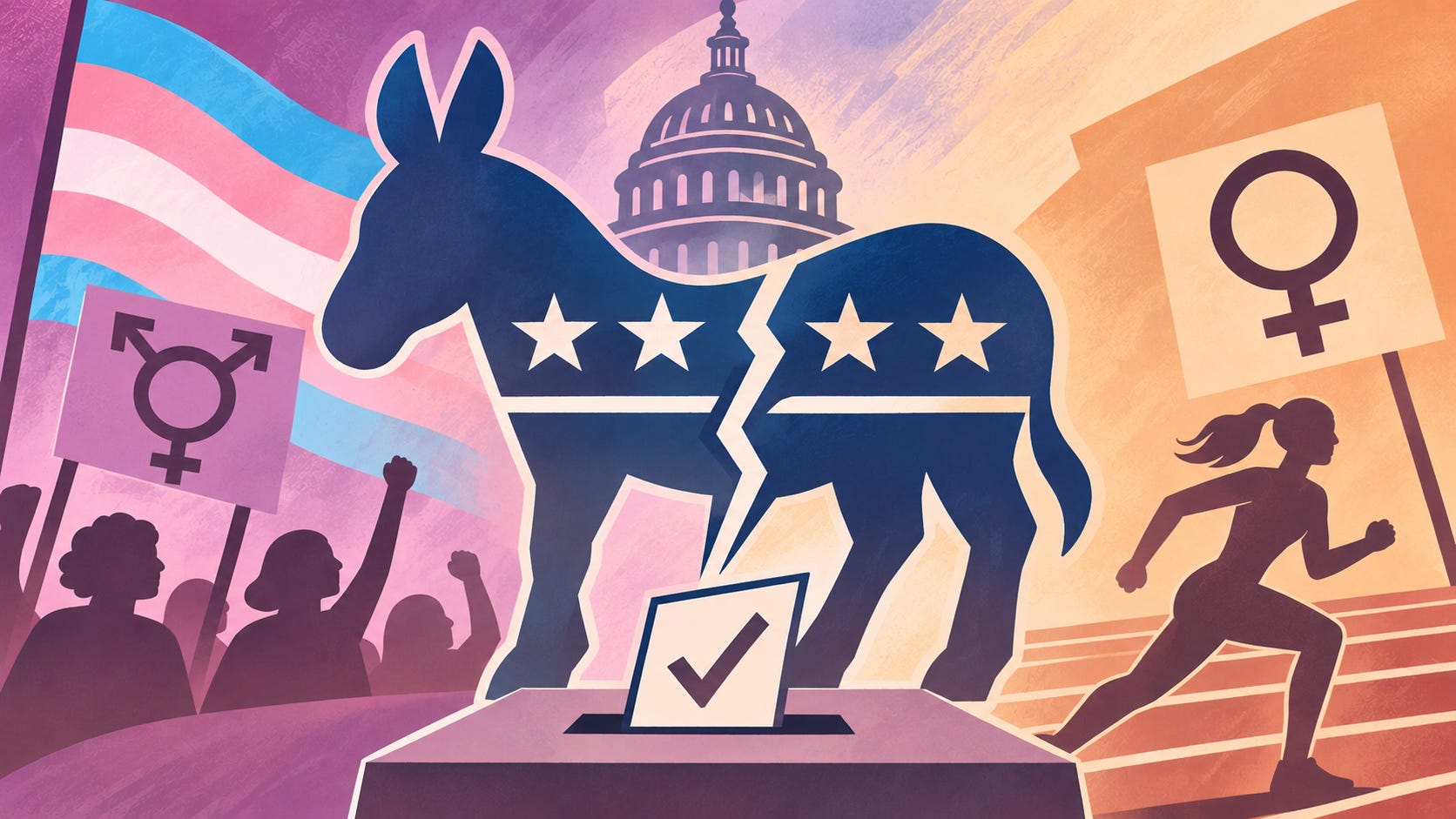
In March 2025, I wrote The Great Rebrand: The Democrats’ Illusion of Moderation, questioning whether Democrats’ sudden embrace of political moderation represented genuine change or merely a messaging strategy. California Governor Gavin Newsom had recently acknowledged the unfairness of male participation in women’s sports, despite his longstanding support for gender-identity policies that raised those concerns. My conclusion was straightforward: They aren’t changing—just changing the script.
Nearly two years later, the 2026 midterms have given me reason to revisit that assessment. Several Democrats openly challenged positions associated with the party, faced criticism from their own allies, and won their elections. Meanwhile, transgender and nonbinary-identified Democratic candidates made history in state legislative races.
So, are Democrats moderating, or is the party’s ideological divide becoming harder to ignore?
The Democrats Who Broke Ranks
In Ohio, Democrat Amy Acton defeated Republican Vivek Ramaswamy after supporting the state’s restrictions on male participation in girls’ and women’s sports, photo voter identification, and Medicaid work requirements. Her positions drew criticism from within her own party. The Ohio Democratic Party’s Pride Caucus sought clarification of her sports position, while Equality Ohio downgraded her candidate score. Acton nevertheless maintained that she would uphold Ohio’s existing sports law.
In my home state of South Carolina, Annie Andrews offered an even sharper contrast. In 2022, she condemned legislation protecting women’s sports and pledged support for transgender youth. Four years later, her Senate campaign featured an advertisement opposing male participation in women’s sports and gender-transition surgeries for minors. The advertisement followed personal attacks from President Trump and she responded by presenting herself as a pediatrician and mother concerned about children’s well-being.
The backlash exposed an internal disagreement. LGBTQ organizations criticized Andrews, while the Young Democrats of South Carolina issued a statement condemning Democrats’ adoption of what it called anti-trans talking points. The statement illustrated how some Democrats regarded the rhetoric associated with her campaign not as reasonable moderation, but as a betrayal of party values. Andrews nevertheless defeated Republican Darline Graham, helping Democrats reclaim a Senate seat they hadn’t won since 1998.
Neither Andrews’ nor Acton’s victory proves that their sports positions determined the outcome, but both demonstrate that Democrats can publicly support sex-based sports restrictions and still win competitive statewide elections.
Mississippi’s Different Kind of Democrat
Scott Colom’s victory over Republican Cindy Hyde-Smith offered another variation on Democratic moderation. He became Mississippi’s first Black U.S. senator elected since Reconstruction, winning in a state that hadn’t elected a Democratic senator since 1982. Colom’s campaign combined support for border enforcement and fairness in girls’ sports with proposals to eliminate federal income taxes for earners making under $75,000, oppose tariffs, raise wages, and protect Medicaid-funded rural hospitals. His appeal wasn’t built around neatly fitting either party’s ideological expectations, but around what he argued would improve Mississippians’ lives.
Following his victory, CNN’s Dana Bash asked whether voters had elected him to work with President Trump or stand up to him. Colom rejected the premise of that choice, saying he intended to hold Trump to his promises on grocery prices, avoiding prolonged wars, and affordable healthcare…a revealing distinction. Political independence doesn’t require opposing everything the other party proposes, nor does cooperation require abandoning accountability.
Colom’s election doesn’t establish that Mississippi voters suddenly embraced the Democratic Party’s broader agenda. However, it does raise a question that extends beyond Mississippi: Are politicians beginning to recognize that constituents’ practical concerns don’t always fit comfortably within party orthodoxy?
One Election, Two Different Stories
And yet…the same election produced another development. As The 19th reported, openly transgender and nonbinary-identified Democrats won historic elections in several states. Georgia elected Bentley Hudgins, its first nonbinary-identified and Japanese-American state lawmaker. Michigan elected Joanna Whaley, its first openly trans-identified state legislator. Alabama, Washington, and Wisconsin also elected trans-identified lawmakers.
Many of these candidates centered their campaigns on familiar economic concerns…Hudgins emphasized affordability and healthcare (👀). Others focused on wages, job training, medical debt, healthcare, workers’ rights, and eliminating the grocery tax. Their campaign priorities overlapped with those emphasized by Democrats taking more moderate positions elsewhere.
Of course, electing a trans-identified politician doesn’t mean voters endorse every gender-identity policy that politician supports. Still, the contrast is revealing…Democrats who publicly acknowledge sex-based distinctions are winning elections while Democrats who identify as transgender are also gaining political representation. These outcomes aren’t inherently contradictory but they may expose unresolved disagreements within the party about sex, gender, and public policy.
A Change of Heart, or a Change of Incentives?
The criticism directed at Acton and Andrews demonstrates that these disagreements aren’t confined to partisan debates. Some Democratic activists regard sex-based sports restrictions as discriminatory, while sex-realist feminists recognize biological sex as essential to fairness and equal opportunity in female athletics. Those differences cannot be reconciled through campaign slogans alone.
In 2025, I was skeptical of Newsom’s sudden concern about fairness in women’s sports…his rhetoric changed, but meaningful policy reform did not follow. I remain skeptical of politicians who discover inconvenient truths when those truths become politically advantageous. However, I’ve also reconsidered whether personal conviction is always the most useful measure of political progress.
Politicians aren’t philosophers, they’re public servants. A candidate who changes position in response to voters may be practicing democratic accountability. One who makes promises without intending to honor them is simply campaigning dishonestly. The difference becomes apparent through governing. Does the politician support legislation consistent with campaign promises? Defend those commitments when activists object?
I would welcome more radical feminist women and male allies in elected office, but a politician need not identify as a radical feminist to recognize that biological sex matters in women’s sports. Agreement on that principle doesn’t require agreement on every other issue. What matters is whether a candidate’s promises they are elected on become policy.
The Party’s Unanswered Question
The Democratic Party may not be moving uniformly toward the center. Instead, its coalition appears increasingly divided over which positions are negotiable and which constitute essential party values. Some candidates are acknowledging sex-based distinctions that progressive activists reject. Others continue advocating gender-identity policies while others emphasize economic concerns rather than making those debates central to their campaigns.
The election demonstrated that these approaches can coexist electorally. Whether they can coexist politically remains to be seen. Will Acton uphold Ohio’s sports restrictions? Will Andrews maintain the position she presented to South Carolina voters? Will Colom translate his campaign priorities into legislation? And how will Democratic organizations respond when elected officials disagree with their preferred policies? Election results tell us who won, but governing records will tell us whether anything has changed.
When I wrote The Great Rebrand, I argued that Democrats were changing their script rather than their policies. The 2026 election hasn’t disproved that argument but it has made the distinction more consequential. Whether these victories produce lasting policy realignment or another round of carefully managed messaging remains to be seen.
Moderation isn’t proved by what a politician is willing to say to get elected. It’s proved by what that politician is willing to do once elected.
This is far from resolved. Newsom will go which ever way helps him become president ; there is no center there. What he would actually do if elected is unknowable and that's always been his mode of operation as he appeals to both sides.
There is a huge rift in the party and trans is joined with the "anti-zionist" elements. These two issues have the potential of becoming front and center and overshadowing the more important economic issues , especially the attacks on Israel. You have activists who are going to make these the litmus tests in the primary. I worry "activists" will take up the oxygen in the room.