


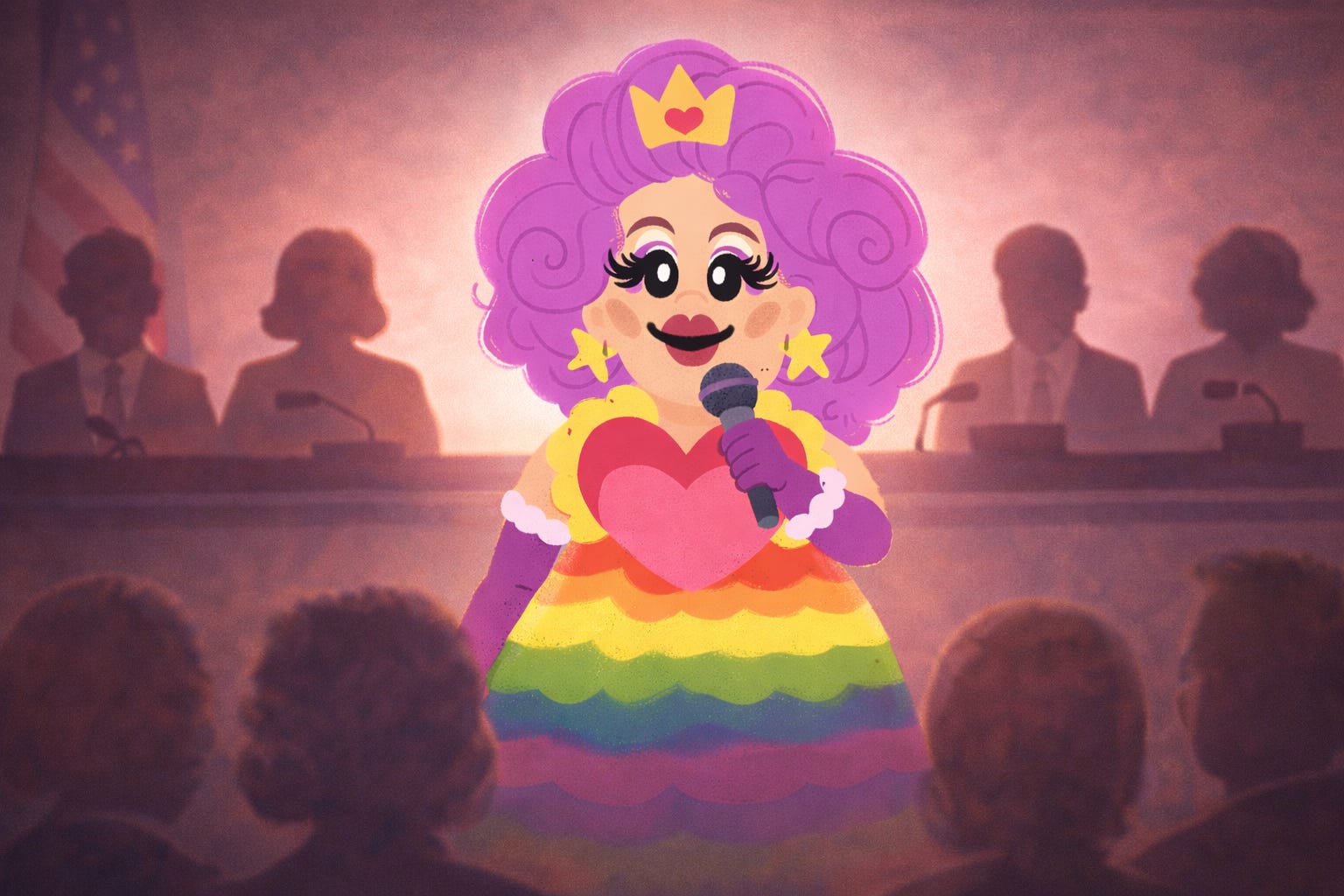
There is something clarifying about a moment when the script falls apart—not the polished messaging or carefully constructed language, but the point at which a simple question is asked and no one can quite bring themselves to answer it. That is what happened during the Ohio hearing on HB 249. Representative Josh Williams did not ask for a theoretical defense of identity or expression. He asked a straightforward question: why should adults be allowed to perform simulated sexual acts in front of minors?
What followed was not an answer but a kind of circling. Concerns about vagueness were raised, references to unnamed existing statutes were offered, and the conversation drifted toward parental discretion. Each response moved around the question rather than addressing it directly, and in that avoidance the underlying issue became more visible than any prepared testimony could have made it.
The Question No One Would Answer
The bill itself is not especially complex. It does not ban drag, criminalize adult performances, or label entire categories of people as obscene. It draws a narrower and more familiar line: explicit sexual conduct belongs in adult spaces, not in the presence of children. The intensity of the opposition to that boundary is what makes the exchange so revealing. When the restriction was described, the response was not to distance oneself from the conduct in question, but to insist that the bill must be targeting them. No one imposed that interpretation; it was offered freely. In doing so, the debate over language and definitions gave way to something more direct. The conduct at issue—simulated sexual activity, masturbation, nudity—was not in dispute. What was in dispute was whether it should be restricted in the presence of minors at all.
This moment cannot be understood in isolation. The person giving testimony against Ohio’s HB 249, Andrew Levitt: drag name Nina West, has not confined his performances to adult-only venues. He has been deliberately positioned in spaces that center women and children. As a Pride ambassador for Lane Bryant, a company built around the needs of plus-size women, he was elevated over the very women the brand exists to serve. He has also appeared in Pride-themed programming tied to Blue’s Clues, content explicitly aimed at children. These are not incidental overlaps but part of a broader pattern in which male adult performance personas are inserted into spaces that were not originally designed to accommodate them.
The Pattern Is Familiar
I recognized that pattern several years ago, before it appeared in legislative hearings. In 2021, I ended a long-standing patronage of Lane Bryant after more than a decade as a customer. That was not a symbolic gesture but a personal decision shaped by experience. It was the store where my mother helped me assemble my first professional wardrobe, where I learned how to present myself with confidence. When the company chose a male drag performer as the face of its Pride campaign, the shift was unmistakable. The issue was not inclusion in any meaningful sense, but substitution. The women who constituted the brand’s customer base—lesbian women, bisexual women, plus-size women—were no longer centered. They had been replaced by a performance of womanhood that was not rooted in female experience. The response I received when I objected was polite and procedural, assuring me that no offense had been intended. But intent was not the point. What mattered was that the space had changed, and once that shift becomes visible, it is difficult to ignore.
The same dynamic now extends beyond women’s spaces into those involving children. During the hearing, the argument that parents should determine what is appropriate for their children was presented as a sufficient safeguard. Yet that principle has always had limits, which is why laws governing obscenity and exposure exist in the first place. Children have never been treated as a general audience for adult sexual expression. What HB 249 reveals is how far that assumption has eroded. Performances that would once have been confined to explicitly adult venues now appear in public settings—libraries, parks, and community events—where the presence of children is not incidental but expected. When those boundaries are questioned, the response is not to clarify or reassure but to resist the boundary itself.
Georgia Already Knows
This tension is not confined to Ohio. In Georgia, lawmakers have already encountered similar questions but have struggled to resolve them. A related bill, HB 671 sponsored by Representative Carmen Rice, advanced out of committee but never reached the House floor, ultimately expiring without a vote. At the same time, the legislature has acknowledged that existing laws are increasingly inadequate in other contexts. HB 171, which addresses AI-generated obscene material involving children, reflects an awareness that technological developments have created new forms of exploitation that older statutes cannot easily address. The inconsistency lies in the response. When the threat is clearly technological, the need for updated law is readily accepted. When the same underlying issue appears in physical spaces—public performances, shared environments—the willingness to act becomes more tentative. Yet in both cases, the question is the same: where are the boundaries, and who is prepared to enforce them?
What the Ohio hearing ultimately revealed was not a disagreement over identity or artistic expression, but an unwillingness to defend a boundary that once required no explanation. The question that was asked—why explicit sexual performances should be permitted in the presence of minors—remains unanswered because answering it directly would require shifting the focus from who is performing to what is being performed. Once that distinction is made, the issue becomes more difficult to obscure.
Boundaries are often reframed as acts of exclusion or hostility, but they function as a form of structure. They recognize that not every space serves the same purpose or the same people. The erosion of those distinctions has already reshaped spaces created for women, often in ways that make them difficult to recognize as such. The same process is now underway in spaces involving children. HB 249 does not resolve every aspect of that shift, but it restates a principle that was once taken for granted: explicit sexual content does not belong in the presence of minors. The fact that this must now be argued is itself an indication of how much has changed.
What the Ohio hearing exposed was not confusion, but reluctance. The boundary is clear: explicit sexual content does not belong in the presence of minors. That principle once required no defense, now it does. The question is no longer whether we understand the line—but whether we are willing to enforce it.
I'm a 67 yo Black woman, no children, and everyone in my existence has always believed in protecting children from harm, the boundaries between adult behaviors and children and the right to sex-separated spaces. And I believe the majority of US society believes same. Yet the minority group who does not hold these values, successfully organized in the past ten years and working through elected officials, Democrats, implemented their ideology while we, the normal majority, were none the wiser. As more normal people wake up, this fight continues.
men are unwilling to call men's behaviour out
even in the face of children