


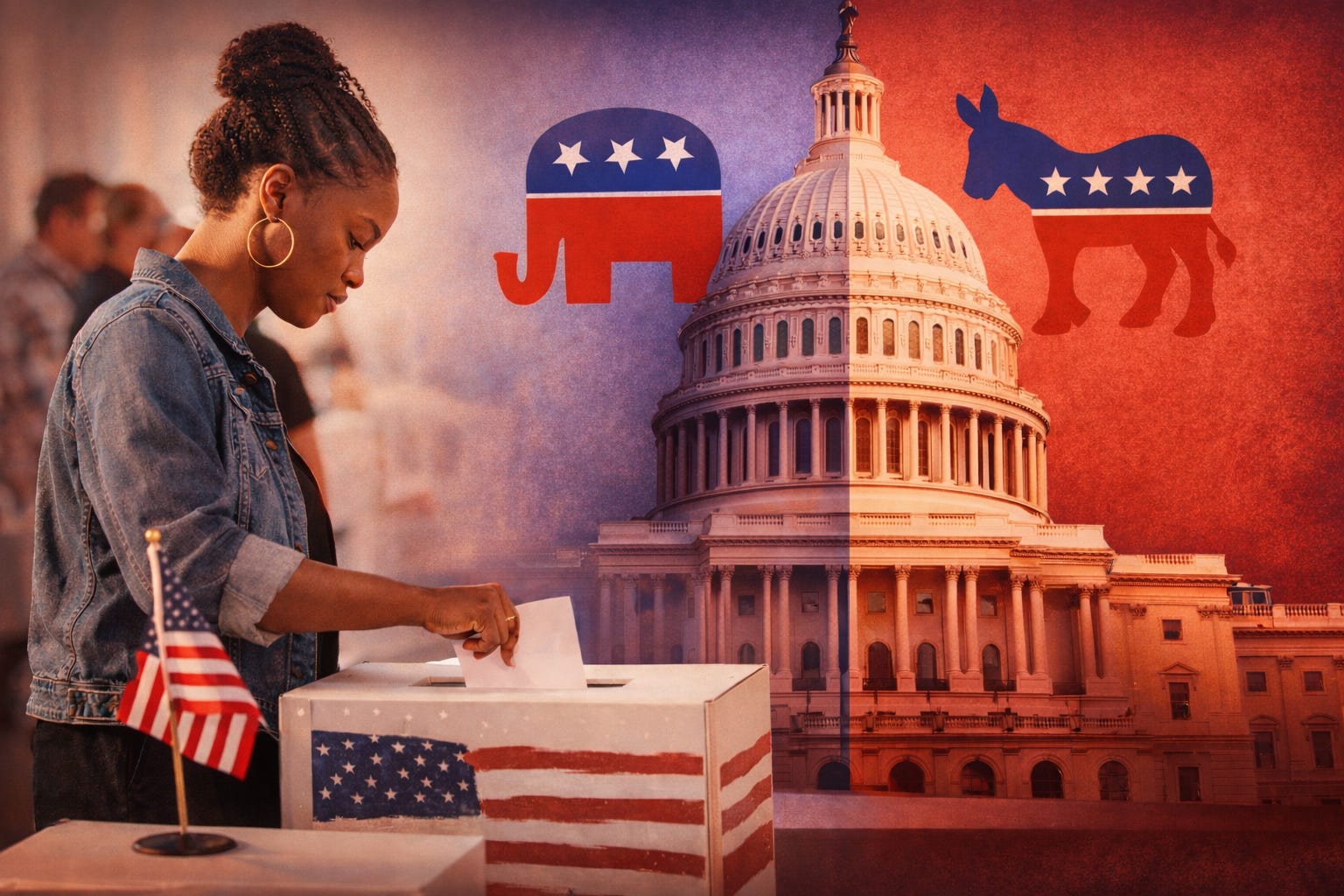
A voting bloc that never moves does not have to be persuaded. It only has to be managed.
That is the quiet reality shaping Black political life in the United States. While other constituencies are courted, segmented, and studied, Black Americans are treated as a foregone conclusion. The expectation is not that our votes will be won, but that they will arrive—reliably, predictably, and in the same direction. And because of that, the conversation around Black political power has become less about negotiation and more about maintenance: how to preserve alignment, how to discourage deviation, how to ensure that the outcome remains stable.
A few weeks ago, I wrote about permission structures—the mental shortcuts that allow people to withdraw empathy once someone has been labeled morally suspect. That framework applies just as clearly here. Political disagreement within the Black community is rarely treated as disagreement alone. It is reframed as betrayal, irresponsibility, or even harm. And once that reframing takes hold, the response shifts. Debate gives way to discipline.
This is not an abstract dynamic. It is visible in how political language is used and who is permitted to deviate without consequence. During the 2020 election cycle, Joe Biden remarked that voters unsure of supporting him “ain’t Black.” The comment was criticized, but it was also absorbed with remarkable speed. It did not fundamentally alter the political relationship it revealed. If anything, it clarified it. The Black vote was not being courted as uncertain; it was being referenced as assured.
That assurance has consequences. Political power depends on leverage, and leverage depends on the credible possibility of movement. A group that can shift its support forces engagement. It compels candidates to compete, to tailor policy, to demonstrate responsiveness. A group whose support is guaranteed, by contrast, becomes easier to deprioritize. Its loyalty is acknowledged rhetorically, but it is not tested materially. Over time, the exchange becomes imbalanced: consistent support given, inconsistent results received.
That imbalance is not only theoretical. It shows up in priorities—what is addressed urgently, what is deferred indefinitely, and who is expected to accept the difference without objection.
In recent years, immigration policy has been framed with urgency, compassion, and moral clarity. Resources, attention, and political capital have been mobilized quickly. In some cases, proposals have extended to forms of financial assistance or benefits that echo—at least in structure—long-standing conversations about reparative justice.
At the same time, Black Americans—whose claims to reparations are rooted in centuries of chattel slavery and state-sanctioned discrimination—are still told those efforts are politically difficult or indefinitely deferred. The contrast is visible.
The issue is not whether immigration policy should be humane. It is whether Black Americans are expected to accept a hierarchy of concern in which their claims remain secondary, while their political support remains consistent.
When that tension is raised, the response is often not engagement but moralization. Concerns about resource allocation or enforcement are dismissed as alignment with the “wrong” side. The label arrives first. The argument is dismissed after.
That pattern extends into public life. In moments of confrontation around immigration enforcement, even Black officers carrying out federal duties have been treated not simply as wrong, but as disloyal. The expectation is not just agreement, but alignment. And when alignment breaks, discipline follows.
What sustains this dynamic is not only party behavior, but community enforcement—and that enforcement is not applied evenly.” The expectation of political alignment is reinforced socially, often more aggressively than it is articulated institutionally. Black Americans are not simply encouraged to vote a certain way; they are expected to police one another into doing so. The consequences for deviation are uneven, but they are real.
The sex-based nature of those consequences is particularly revealing. Black men who express political divergence are frequently criticized, but they are still afforded a degree of individual framing. Figures like Kanye West or Ice Cube are cast as unpredictable, controversial, or strategic. Their choices are treated as their own.
Black women, by contrast, are more likely to be positioned as representatives of the collective. When they depart from expected political positions, the reaction is not merely disagreement but correction. Nicki Minaj, Chrisette Michele, and Rozonda ‘Chilli’ Thomas have each faced backlash that extended beyond critique into reputational and professional consequences. The message is rarely stated outright, but it is widely understood: political deviation carries a higher cost for Black women because it is interpreted as destabilizing the group itself.
This dynamic does more than constrain individual expression. It weakens collective power. Every other major demographic group in the United States contains visible political diversity. There are liberals and conservatives, Democrats and Republicans, within every racial and ethnic community. That internal variation does not dilute those groups’ influence; it strengthens it. It forces both parties to compete for different segments of the same population.
Black Americans, by contrast, are far less politically distributed. The result is a bloc that is easier to model, easier to predict, and ultimately easier to take for granted. A voting population that does not meaningfully split cannot surprise anyone. And without the capacity to surprise, it loses its negotiating power.
The solution is not ideological uniformity in a different direction. It is not a call for Black Americans to adopt any particular party affiliation, nor is it an argument that one party is inherently more deserving than another. It is a call to reconsider the structure of political loyalty itself. When allegiance becomes fixed, accountability erodes. When support is conditional, responsiveness increases.
Independence—whether formal or functional—introduces the possibility of movement. It disrupts assumptions. It forces candidates to ask not just how to mobilize Black voters, but how to persuade them. It shifts the relationship from one of expectation to one of engagement. And in doing so, it restores a basic principle of democratic participation: that votes are earned, not owed.
When Black women are supported only when they reinforce dominant narratives—and penalized when they diverge—the standard being applied is not solidarity, but compliance.
Communities reveal their priorities not only in what they affirm, but in what they punish. If political independence is met with social sanction, then the message is clear: unity is being preserved not through shared interest, but through enforced conformity. And this comes at the expense of long-term power.
A voting bloc that must be earned is a voting bloc that matters. A community that can move is a community that cannot be ignored. The question is not whether Black Americans will continue to participate in politics. It is whether that participation will remain predictable enough to be taken for granted—or become flexible enough to demand results.
Because in the end, political systems respond not to loyalty, but to leverage.
And leverage begins the moment a vote is no longer assumed—and must be earned.