


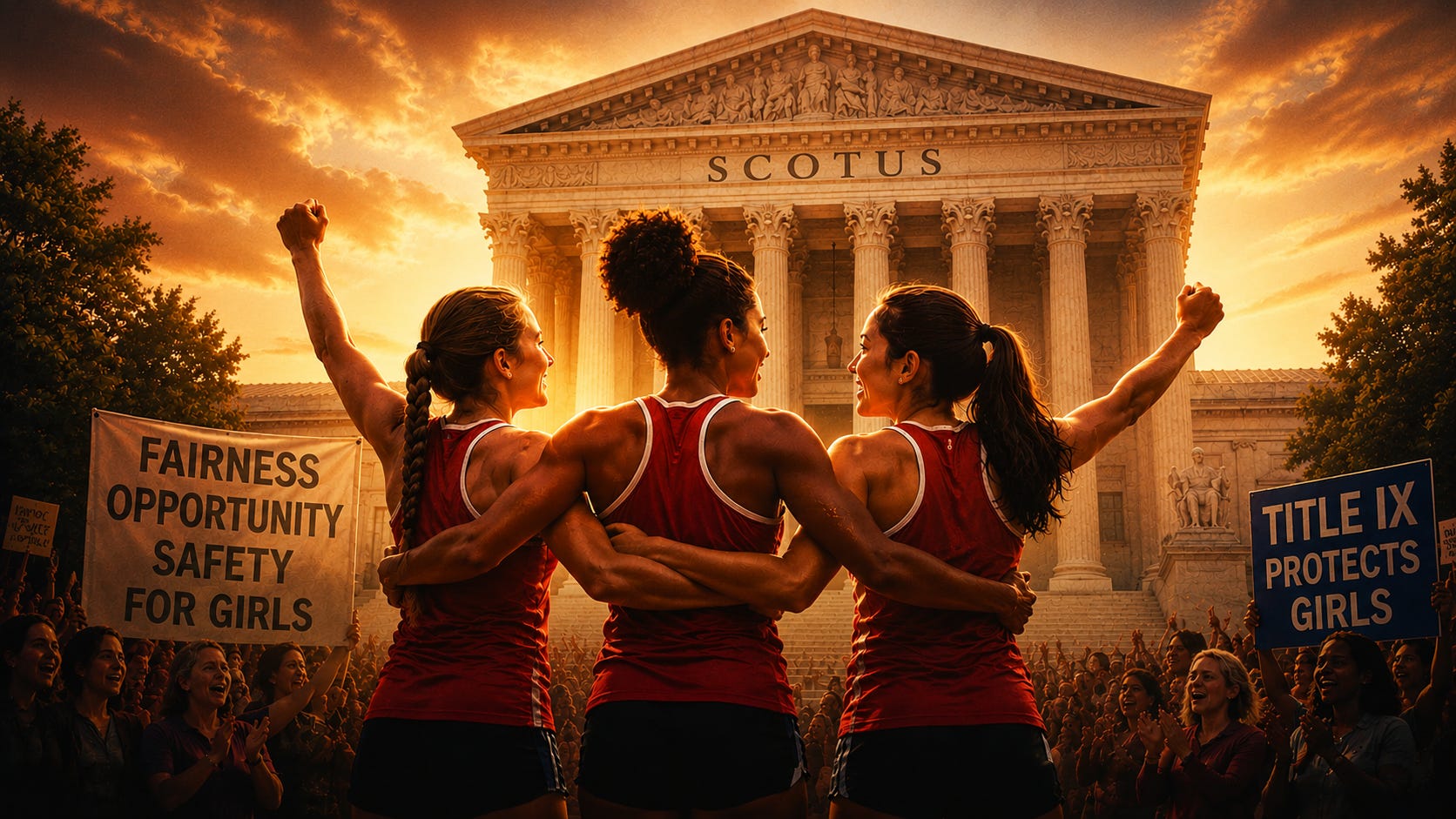
Six months ago, I wrote What the Supreme Court Is About to Decide for Our Daughters and argued that the cases of B.P.J. v. West Virginia and Little v. Hecox represented far more than a dispute over school athletics. They were a constitutional test of whether women remained a legally coherent class and whether the protections secured through Title IX would continue to mean what generations of women believed they meant.
Today, we have an answer. It is a legal answer, but it carries cultural implications that extend far beyond athletics.
In a 6-3 decision authored by Justice Kavanaugh, the Supreme Court held that schools may maintain women’s and girls’ sports for biological females and that doing so violates neither Title IX nor the Equal Protection Clause. The Court concluded that Title IX’s use of the word “sex” refers to biological sex and that schools may determine eligibility for female sports accordingly. It further held that states have important interests in preserving safety, competitive fairness, and equal athletic opportunities for women and girls.
The legal significance of this decision cannot be overstated, but neither can its cultural significance.
The Court Has Reaffirmed What Title IX Was For
The opinion opens by acknowledging something that has too often been forgotten in recent years: Title IX transformed American life because it recognized the reality of female disadvantage and sought to remedy it. The Court notes that before Title IX, girls’ participation in sports was a fraction of boys’ participation and that sex-segregated teams were not a form of discrimination, but a mechanism for ensuring equal opportunity.
This matters because much of the public debate over women’s sports has been conducted as though female-only categories were arbitrary exclusions in need of justification. The Court rejected that framing.
Instead, it recognized what women have been saying for years: separate female sports exist precisely because the sexes are physically different and because, absent those categories, girls’ opportunities would be diminished. The Court expressly acknowledged concerns about both safety and competitive fairness and recognized that allowing males to compete in female sports can displace girls from rosters, playing time, medals, and other opportunities.
In other words, the Court did not merely permit states to maintain female sports. It recognized the reason female sports exist in the first place…and that is no small thing.
A Legal Victory Does Not Erase a Cultural Problem
There will undoubtedly be celebrations today, and understandably so. Women and girls have won an important legal victory. But legal victories often create the illusion that the work is finished. It is not. The fact that these cases reached the Supreme Court at all should concern us. And a court opinion cannot restore every opportunity already lost or undo every social cost borne by the women who spoke up.
The question before the Court was whether protections created to remedy female disadvantage should be reinterpreted to require female disadvantage. That argument was serious enough to divide lower courts. It was persuasive enough to gain national institutional support. And it was advanced in a culture that increasingly treats women’s boundaries as negotiable whenever maintaining them risks appearing insufficiently compassionate. The Court has now answered the legal question. The cultural question remains.
The decision may also prove consequential beyond athletics. A Court willing to reaffirm that sex is a legally meaningful category and that female protections can serve important governmental interests has done more than preserve girls' sports. It has reminded the country that laws recognizing sex are the means by which women secure equal opportunity and safety.
Why were so many people willing to entertain the proposition that a law enacted to create opportunities for girls should be used to compel girls to surrender those opportunities? That answer lies beyond constitutional doctrine.
It lies in a culture that too often rewards the appearance of compassion more than the exercise of responsibility.
Silence Creates Vacuums
One of the central arguments of my earlier essay was that this ideology survives largely in silence. I think that remains true. Many mothers held (and still hold) private concerns about these issues but hesitated to express them publicly. They worried about social friction, professional consequences, or being labeled intolerant. That hesitation created the illusion that concern for women’s rights was rare.
It wasn’t.
The last several years have demonstrated the opposite. Twenty-seven states enacted laws preserving female sports for girls and women. Major sporting bodies, including the NCAA, the U.S. Olympic and Paralympic Committee, and the International Olympic Committee ultimately adopted policies grounded in biological sex. The Supreme Court itself noted this convergence in its opinion.
When people speak, they often discover they are not alone. This is true in legislatures. It is true in communities. And it is true in families.
Mama Bears Were Never the Problem
When I wrote about these cases in December, I argued that mothers of daughters were being asked to subordinate their children’s material interests to ideological conformity. I argued that we needed more mama bears and fewer shrinking violets, and I believe that even more strongly today.
Because the women who spoke up about this issue were frequently told they were overreacting, hateful, or on the wrong side of history. Mothers who raised concerns about fairness in sports, privacy in changing spaces, or the long-term implications of redefining sex-based rights were often treated as obstacles to progress rather than citizens participating in a democratic debate.
Yet today’s decision demonstrates something important: these concerns were not fringe. They were not irrational. They were not invented. They were rooted in realities that the Court itself ultimately recognized.
That should give many women permission to trust their own judgment a little more. And perhaps, next time, to speak a little sooner.
The Lesson for Mothers
I write this today as I wrote six months ago: not only as a citizen concerned with civil rights law, but as a mother raising a daughter who will inherit the precedents and cultural assumptions of this moment.
The Court’s decision means my daughter will grow up in a country where Title IX still recognizes her as part of a legally meaningful class: girls. That matters.
But rights survive not only because courts recognize them. Rights survive because ordinary people insist they remain worth defending. The lesson of these cases is not that mothers can now relax, but that mothers were right to speak up in the first place.
They were right to write their legislators. Right to testify. Right to challenge the false consensus in their schools, churches, and social circles. Right to insist that girls deserve opportunities designed for girls.
Lawmakers still need to hear from real women rather than only from professional advocates and well-funded organizations. Communities still need mothers willing to say aloud what many privately believe. And girls still need adults willing to bear the social costs of protecting their interests.
The Supreme Court has spoken. Now the culture must decide whether it has learned anything from the last six years, because today's decision did not create the need for mama bears—it merely proved why we needed them all along.
It is the responsibility of adults , "alleged" grownups, to speak up and do the work of protecting and advancing young girls. The complete and utter failure of Democrats to do this, is an indication of the degree they have abandoned what were once basci principals of the Democratic Party. They have not been this far on the wrong side of history since they were the party of slavery. I honestly do not see how they come to their senses and embrace reality. Our obligation as adults is to the protection of youth and not a political party. If that means voting them out of office, so be it.
In California , the contest between Sanja Shaw , Republican , and Richard Barrera, Democrat, for Superintendent of Public Education presents a clear choice between someone who strongly supports the biological reality of male and female, and would work to insure that is enforced in schools as opposed to indoctrinating a perverse idiology , and a Democratic who seems incapable of acknowledging the reality of there being only two sexes , and supports the "gender idiology" . Will the "grownups" show for this election?
Sadly Roberts’ SCOTUS has so badly damaged its own credibility that “be kind” can pin this on bigotry.
And it might well be on the part of the Rs.
But that doesn’t make it the wrong decision, just like Skrmetti was also the right decision.
Those who promoted and pushed medical experimentation on children will not go gently into the night … they can’t admit to themselves what they’ve enabled & the damage they’ve done to progressive politics, as it would reveal that they are as unprincipled as their MAGA counterparts.