


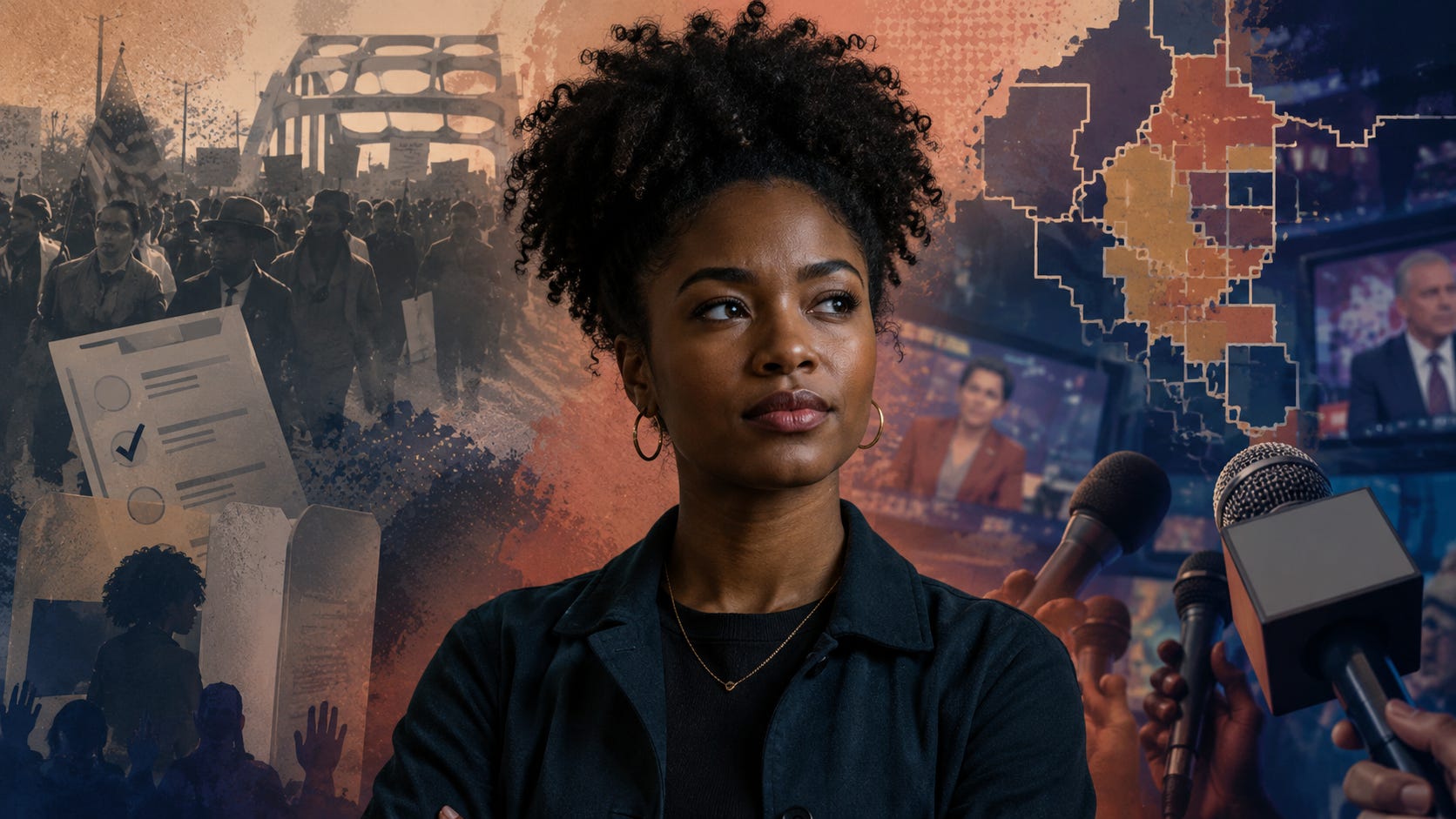
Every election cycle now comes with the same warning: democracy is under attack, Black voting rights are being gutted, and America is sliding backward toward Jim Crow.
The language is powerful because the history is real. Black Americans do not have to imagine political exclusion. Our communities still carry the weight of poll taxes, literacy tests, intimidation, violence, and the long fight to secure a basic right that should never have been denied in the first place.
But that history also makes us politically vulnerable to manipulation, as the left increasingly treats any reduction in Democratic power as if it were a reduction in Black political power. Every lost district becomes disenfranchisement. Every shift in political advantage becomes voter suppression. Partisan losses are reframed as racial crises.
But Black Americans are still voting…so what, exactly, was taken away?
Earlier this year, I wrote that a voting bloc that never moves does not have to be persuaded. It only has to be managed. The reaction to recent redistricting battles has only reinforced that point.
That question matters because voting rights are too important to be collapsed into partisan panic. There is a difference between losing the right to vote and losing a district that helped one party maintain control. There is a difference between Black Americans being denied political participation and Democrats losing a political structure they had come to depend on. Those are not the same thing but pretending they are serves a specific purpose.
For decades, Black voters have been treated as the moral face of Democratic urgency. When the party needs emotional force, our history is invoked. When it needs legitimacy, our struggles are placed at the center. When it needs fear, our past is pulled forward and presented as the future waiting just around the corner. The result is a familiar pattern.
Black Americans are asked to feel existentially threatened whenever Democrats lose institutional advantage. But lost Democratic power is not automatically lost Black power.
That distinction is especially important in redistricting fights. District lines are political tools. They can shape outcomes, protect incumbents, weaken opponents, and preserve party control. Both parties understand this. Both parties use the process strategically when they can. What matters is whether every electoral shift that weakens Democratic certainty should automatically be framed as an ck voting rights.
If Black citizens can still register, still vote, still organize, still persuade, still run candidates, and still participate in elections, then the issue is not whether Black people have been erased from democracy. The issue is whether one party has lost a favorable arrangement. And that is a political problem, not a civil rights crisis.
None of this means race is irrelevant or that history no longer shapes political outcomes. Nor does it mean Black communities should be naïve about power. But it does mean we should be careful when partisan actors use our history as emotional packaging for their own losses. Because there is something deeply revealing about a political system that only talks about Black power when Democratic power is threatened.
Where is that urgency when Black communities ask for safer neighborhoods? Better schools? Serious economic investment? Protection for women and children? Actual accountability from leaders who have taken our votes for granted for generations? The emergency seems to arrive on schedule when party control is on the line…and that should tell us something.
When one party believes it owns the Black vote, and the other party assumes it can never win it, Black Americans are left with very little leverage. Political power is built through competition. A vote that can move must be courted. A vote that is guaranteed can be praised, photographed, and emotionally flattered while being materially neglected. That is political captivity!
If Black political power depends entirely on preserving predictable Democratic outcomes, then it is worth asking what kind of power that really is. A community whose votes are permanently assumed is no longer being courted as citizens to persuade, but managed as electoral property.
A competitive political environment is not inherently anti-Black. In fact, it may be the only thing that can force both parties to stop treating Black voters as settled territory. If Democrats had to earn Black votes instead of assuming them, they would have to deliver more than symbolism. If Republicans believed Black voters were actually reachable, they would have to do more than write us off. This kind of competition would make Black voters more powerful…not less.
But the current arrangement benefits too many people. It benefits Democrats, who can invoke Black history while relying on Black loyalty. It benefits Republicans, who can avoid serious engagement by assuming Black voters are permanently unavailable. And it benefits media institutions that know racial fear remains one of the most effective ways to produce political compliance. It does not benefit Black Americans.
It especially does not benefit Black women, who are often expected to serve as the emotional and moral guardians of the approved political narrative. We are praised when we reinforce the story. We are corrected when we question it. Our independence is treated as dangerous because it threatens the illusion of unity.
Radical feminism teaches us to notice when a group is being used symbolically while being denied material accountability. Women know this pattern well. We are turned into slogans, signs, and sentimental appeals while our actual needs are pushed aside. Women are often expected to absorb instability quietly in order to preserve institutional harmony. Black voters are often expected to perform a similar political function: remain loyal, remain emotionally available, and remain morally useful regardless of material return.
We are invoked constantly, but not necessarily heard. That is why this issue deserves more skepticism than the mainstream framing allows. Black Americans are not powerless children who must be politically managed for our own good. We are citizens. We can weigh competing interests. We can distinguish between actual disenfranchisement and partisan inconvenience. We can honor the blood-stained history of voting rights without allowing that history to be used as a leash.
The right to vote matters, but the right to think independently matters too. Black political power does not disappear the moment Democrats lose control. If anything, genuine power begins when our votes can no longer be assumed.
A community that can move is a community that must be answered.
A voting bloc that must be earned is a voting bloc that matters.
“None of this means race is irrelevant or that history no longer shapes political outcomes. Nor does it mean Black communities should be naïve about power. But it does mean we should be careful when partisan actors use our history as emotional packaging for their own losses. Because there is something deeply revealing about a political system that only talks about Black power when Democratic power is threatened.”
Thank you Kristen. I couldn’t put my finger on why so much outrage has been focused on the “racism” that is supposedly “inherent” in the current gerrymandering shenanigans. It rings false because of the reasons you articulate. To be clear I don’t love gerrymandering from either party but unfortunately it has been going on almost as long as our country. But the chants of racism from the Democrats in power assumes that black people are a monolith and resides within the Democratic Party. It also assumes (incorrectly) that the interests and beliefs of the black community perfectly aligns with the Democratic Party platform and that should never be questioned.
I’ve been told these things, and that I only care about certain ppl which isn’t true. I want every legislator to do what is right and fair and helpful for every person. 🙏🙏🙏🙏🥺