


In April 2024, I wrote an essay about Kyle Rittenhouse that was not really about Kyle Rittenhouse. His campus speaking tour was generating the predictable petitions, protests, and counter-protests, but I found myself thinking instead about the summer of 2020 and what had become of the Black Lives Matter movement. I had watched a movement that began with enormous public sympathy lose much of it amid riots and political radicalism that extended well beyond concerns about policing. In Portland and elsewhere, predominantly white anarchists attached themselves to racial-justice demonstrations and pursued their own anti-establishment objectives under the same banner. Whatever legitimate grievances had brought people there became increasingly difficult, in the public mind, to separate from everything happening around them.
The lesson I took from it was fairly simple: not all allies are good allies.
I called the essay “Rittenhouse and a Call to Clean House,” and argued that social movements have an obligation to scrutinize the people acting in their name. A cause can be legitimate and still attract people whose motives are not. A movement can begin with one objective and find itself providing infrastructure or legitimacy for another. I was thinking primarily about infiltration then—outsiders entering a movement and redirecting its energy toward purposes the ordinary person who joined it might never have endorsed.
More than two years later, I am not sure infiltration is always the right word.
I have been thinking about that old essay while watching the controversy engulfing Ed Sheeran’s Loop Tour. At a September 4 show, Macklemore opened for Sheeran at MetLife Stadium and used part of his set to advocate for Palestinians, telling the audience that a significant reason he wanted to join the tour was the opportunity to stand in stadiums and say “Free Palestine.” What happened afterward is more complicated than some social-media retellings suggest: Sheeran says he did not personally fire Macklemore; according to him and tour promoter Messina Touring Group, venues hosting upcoming dates refused to proceed with Macklemore on the bill.
Macklemore, like anyone else, is free to express his political convictions. That does not resolve the separate question of whether an invited performer is entitled to use someone else’s tour and audience for political advocacy. The artists who withdrew are similarly free to decide where they will perform, just as venues can establish their own limits and Sheeran can want his concerts to remain largely apolitical. What interests me is what happened when those competing choices collided, because the resulting controversy looks less like a disagreement over one performer and more like something I have been watching develop around the Free Palestine movement for several years.
The political scientist in me keeps returning to a basic problem of coalition politics. Successful movements bring together people who agree strongly about one thing while disagreeing about many others. The contemporary Free Palestine coalition includes Palestinians and Muslims alongside secular Western progressives, socialists, antiwar activists, humanitarian organizations, students, supporters of a two-state solution, opponents of Zionism, and people whose primary concern is the conduct of the Israeli government in Gaza. Those constituencies do not necessarily share a worldview…they share an issue.
Broad coalitions therefore depend on boundaries: some understanding of what membership requires, what behavior will be tolerated in the movement’s name, and what people are allowed to disagree about while remaining allies. This is where my thinking has changed since 2024. Infiltration suggests outsiders entering a coherent movement and pulling it away from its purpose, but movements can transform without anyone infiltrating them at all.
A coalition can organize around a broadly sympathetic cause and gradually allow its most uncompromising members to determine what solidarity requires. The price of belonging rises incrementally. Sympathy becomes advocacy. Advocacy becomes allegiance. Allegiance becomes participation. Eventually, declining to participate is interpreted not as neutrality but as opposition, and people who agreed about the original grievance discover that agreement is no longer sufficient.
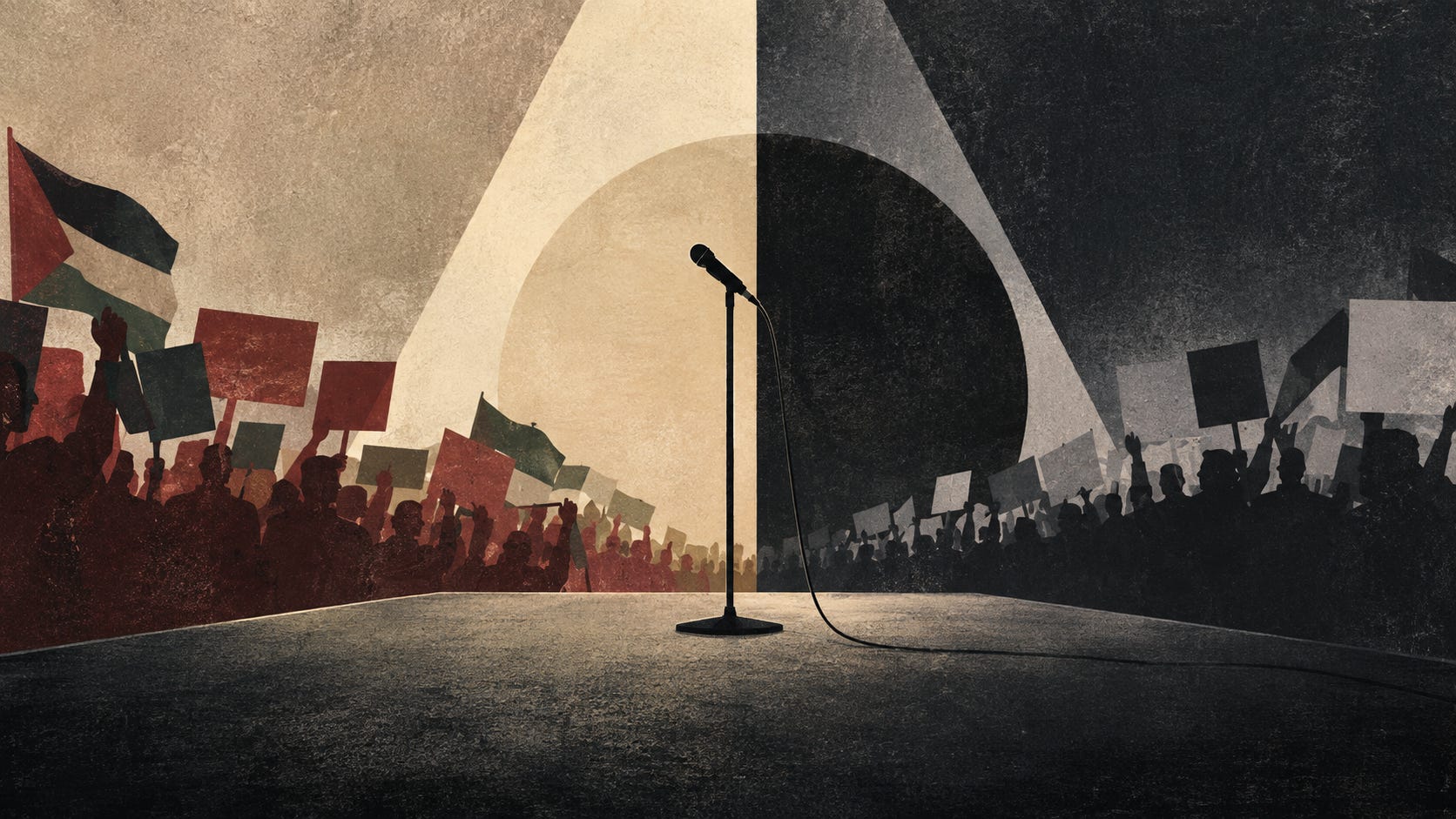
Increasingly, in Western political and cultural spaces, “Free Palestine” can operate as more than an expression of concern for Palestinians. It can become a loyalty test: Have you spoken about Palestine? Have you spoken enough? Did you use the right language? If you spoke about another humanitarian catastrophe, why did you not mention Gaza? If an artist advocates for Palestine from your stage, must you permit it? If you do not, what does your refusal mean?
The issue is no longer simply whether someone cares about Palestinians. The dispute becomes whether everyone else must demonstrate that care in the prescribed way.
That is what makes the insistence that “silence is complicity” politically consequential: it eliminates the neutral category. If silence itself constitutes participation in injustice, declining to join is not actually an available choice. There are only participants and opponents, with little room for someone who believes civilians are suffering but does not share the movement’s politics, knows too little to offer an informed opinion, or simply came to a concert to hear music.
Social movements have always tried to persuade neutral people that inaction has consequences, sometimes for good reason. But when that organizing tactic expands without limit, every institution becomes a potential political venue, every public figure is expected to speak, and even competing humanitarian concerns must be filtered through the movement’s priority issue. If disagreement over tactics or boundaries becomes indifference to suffering, the movement has also built an effective defense against internal criticism.
The Free Palestine coalition also presents a complication I did not fully explore when I wrote about Black Lives Matter in 2024: Western leftists and Islamist movements can share enemies without sharing political ends. Iran’s 1979 revolution offers an extreme historical example. Secular liberals and leftists joined the broader opposition to the Shah alongside a much more powerful Islamist movement, only for the Islamic Republic that emerged to repress many of those former fellow opponents. Contemporary Palestine activism may not be a replay of the Iranian Revolution, but the underlying coalition problem remains worth considering: opposing the same thing does not mean political allies are trying to build the same thing afterward.
How much of what Western activists understand themselves to be supporting is actually shared by Palestinian political factions, and how much is Western progressive politics projected onto a conflict with its own history, religion, nationalism, and competing political movements? When explicitly Hamas-sympathetic rhetoric appears within demonstrations organized around Palestinian civilians or self-determination, who within the coalition is responsible for saying it does not represent them?
Movements rarely enjoy policing their own side while they believe themselves to be fighting something worse. Internal criticism feels like disloyalty; drawing boundaries feels like weakening the coalition. Questionable rhetoric can therefore be explained away or ignored because preserving solidarity feels more urgent than examining what solidarity is becoming.
That was ultimately my frustration with Black Lives Matter after 2020. The coalition became very good at identifying enemies and considerably less interested in asking whether everyone standing beside it was actually a friend. I wrote then that activists had to protect “the integrity of their cause” against people whose intentions might not align with the movement’s goals.
I still believe that, but I would write the argument differently today because the danger is not limited to people with bad intentions. Sometimes the problem is people with perfectly sincere intentions who simply want something different from what everyone else thought they had signed up for.
I do not need to believe that Western activists are secretly working toward an Islamist political order to notice that some appear reluctant to scrutinize the politics of people they regard as allies. Nor do I need to establish that Palestinian or Hamas-linked organizers deliberately engineered the Western movement into what it has become. The broader political problem exists either way: a movement that cannot establish its own boundaries will eventually have those boundaries established by its most demanding participants.
Which brings me back to Ed Sheeran.
Macklemore’s politics were hardly a secret when he joined the tour, but his explanation of why the Sheeran dates mattered is revealing: part of the attraction was access to stadiums full of people. From an activist’s perspective, that makes sense…a crowd of tens of thousands is an opportunity to speak, but it was an audience somebody else built.
The dispute was therefore a conflict between two understandings of what the stage was for: Macklemore saw a platform capable of carrying a political message; Sheeran has described a concert environment he wanted to remain welcoming across political divides. The more interesting political question is what happens after someone says no.
If refusal itself proves complicity, boundaries become almost impossible to maintain. The venue cannot merely be a venue. The singer cannot merely be a singer. The audience cannot merely be an audience. Everything becomes another front in the political struggle and anyone unwilling to make it one becomes politically suspect.
That is not unique to Palestine. American politics has spent years turning consumer choices, entertainment, corporations, schools, sports, churches, friendships, and ordinary social interaction into opportunities to demonstrate political identity. We have seen similar dynamics when other movements have moved from asking for tolerance to requiring affirmation, until declining to adopt the movement’s language or assumptions is itself treated as hostility. But the Free Palestine movement offers an unusually concentrated example of what happens when one issue acquires enough moral urgency among its supporters that other institutions are expected to subordinate their purposes to it.
It’s similar to a lesson we’ve already seen unfold elsewhere. The gay-rights movement spent decades building public support around same-sex relationships, marriage, and protection from discrimination, only for many of its institutions to later bind those gains to far more contested claims about gender identity, sex-segregated spaces, sports, and medical interventions. Americans themselves appear to distinguish between the two: support for same-sex marriage remains a majority position even as majorities reject some policies advanced under the broader LGBT umbrella. Yet support for same-sex marriage has also slipped from recent peaks. That does not prove transgender activism caused the decline, but it raises a question movements ignore at their peril: when a successful coalition continually expands what agreement requires, can its new demands eventually place its older victories at risk?
I ended my 2024 draft by arguing that the strength of a movement lies “not in the number of its supporters, but in the integrity of their intentions.” Two and a half years later, I still believe that, but I think I left something out.
The health of a political movement can also be measured by the boundaries it is willing to maintain. Can it distinguish sympathy from allegiance? Can it accept an ally who agrees with its ends but not all of its methods? Can it tolerate someone who cares differently, cares less, or declines to organize his life around the cause at all? Can its supporters enter institutions they did not build without insisting those institutions reorganize themselves around their politics? And can people within the movement ask those questions without immediately becoming suspect themselves?
Black Lives Matter should have taught us what can happen when a movement becomes reluctant to scrutinize the people acting in its name. The controversy surrounding Ed Sheeran suggests another lesson: movements need boundaries not merely to keep hostile people out, but to prevent solidarity itself from becoming an ever-expanding obligation.
In 2024, I thought the warning was that not all allies are good allies. I still think that is true. What I understand better now is that a movement also has to leave room for people who are not allies at all—not enemies, not opponents, not immoral cowards waiting to be shamed into compliance, but people who simply decline to join. Because once a political movement decides that neutrality is itself an act of aggression, it creates a world with only two available positions: obedience and opposition. And at that point, the most revealing question may no longer be why someone refused to say the right words, but why saying nothing was no longer permitted.