


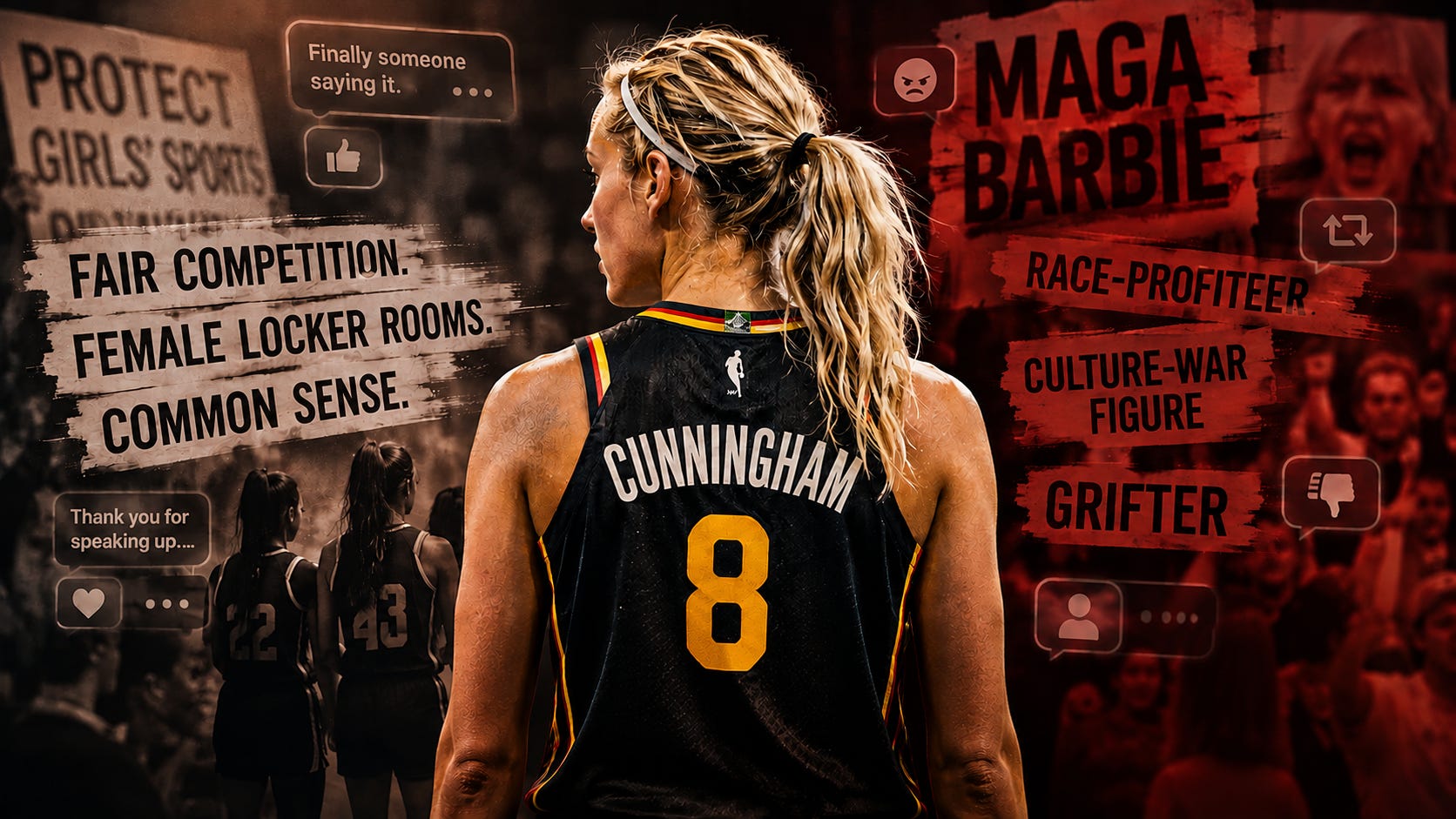
“I also think with that love is truth, being honest. And I want to protect young girls in a locker room, or young girls in sport who shouldn’t have to go against biological men.” — Sophie Cunningham
It is worth pausing over what, exactly, is supposed to be objectionable about that statement.
Cunningham did not argue that “transgender” people should be denied their civil rights. She did not express hatred toward anyone. She did not call for exclusion from public life. She simply said she wanted girls to have fair competition and female-only locker rooms. Until very recently, those would have been regarded as entirely ordinary observations. Today, they are enough to earn a professional athlete the nickname “MAGA Barbie.”
In fact, some commentary barely engages Cunningham’s statement at all. One recent essay in The Guardian portrays Cunningham as a culture-war figure whose popularity is intertwined with conservative politics and racial polarization, devoting far more attention to her race, presumed audience, marketability, and motives than to the substance of what she actually said.
That rhetorical shift is the story worth examining.
The most revealing aspect of the backlash is not disagreement but how quickly the conversation moved away from Cunningham’s actual claim. Rather than asking whether girls deserve female-only sports and locker rooms, critics began asking different questions altogether. Why hadn’t Cunningham spoken more forcefully about Black WNBA players receiving abuse? Why hadn’t she publicly condemned every instance of harassment within the league? Why had she chosen to speak about this issue instead of another?
Those may be worthwhile conversations in their own right. They are also red herrings.
None of them answer the question Cunningham actually raised. Instead, they shift attention from whether her argument is true to whether she has earned the moral right to make it. As I’ve written before, changing the story often changes our moral instincts. Once the discussion becomes about Sophie Cunningham rather than girls’ sports, people begin evaluating her character instead of her argument and the girls quietly disappear from the center of the story.
That is why the label “MAGA Barbie” matters. It is not merely an insult directed at one athlete but a rhetorical device. If protecting girls’ sports and locker rooms can be branded as “MAGA,” then the principle itself becomes politically suspect. The goal is no longer simply to malign Sophie Cunningham. It is to make ordinary, commonsense observations appear partisan, encouraging people to hesitate before saying aloud what they have long understood to be true.
The irony is that Cunningham’s position is hardly revolutionary. The WNBA’s own Collective Bargaining Agreement states plainly that only women are eligible to play in the league. That provision has never been regarded as discriminatory because the league exists to preserve athletic opportunities for women. Women’s sports are not an exception to equality but one of the ways equality is achieved. Female athletic categories exist because average biological differences between the sexes affect speed, strength, power, and endurance. Protecting those categories is not an attack on anyone else. It is the reason women have a league of their own.
Even if every criticism of Cunningham’s activism were true, it still would not answer her argument. At most, it would suggest she has been inconsistent in her advocacy. But inconsistency is not the same thing as being wrong. Whether Cunningham has spoken often enough about racism, online abuse, or every other controversy within the WNBA has no bearing on whether girls deserve female-only sports and locker rooms.
Underlying much of the criticism is another expectation that deserves examination: the idea that women must first prove themselves advocates for everyone before they are permitted to advocate for themselves. Men are rarely expected by other men to demonstrate equal commitment to every other constituency before speaking on behalf of their own. Women, by contrast, are routinely asked to pass that test.
We all belong to multiple affinity groups. As a woman, I write about women’s rights. As a Black American, I write about issues affecting Black Americans. As a mother, I write about the world we are leaving our children. Healthy civil society depends upon different people carrying different concerns while respecting one another’s efforts. I do not expect every person outside those groups to risk their livelihood, personal safety, or even comfort fighting my battles. My expectation is much simpler: don’t stand in my way while I fight them myself.
Voluntary solidarity is admirable. Mandatory solidarity is an impossible standard.
That principle also shapes how I think about political coalitions. I am under no illusion that agreement on one issue produces solidarity on every other. Conservative spaces can harbor anti-Black prejudice. Gender-critical and radical feminist spaces can too, often in forms that are less overt but no less real—racial paternalism, cultural ignorance, or assumptions born from unfamiliarity…Progressive spaces are hardly immune to anti-Blackness either. Because many liberals understand racism primarily as something practiced by their ideological opponents, they can also be resistant to recognizing racial blind spots within their own movements.
Black women deserve to have our concerns taken seriously because they are our concerns—not because they can be summoned whenever someone needs to invalidate another woman’s argument. As I’ve argued before, Black people are not rhetorical devices.
No political tribe has a monopoly on either virtue or vice. Precisely because I recognize those limitations, I have never expected ideological allies to become champions for every aspect of my identity. I do not need conservatives to become experts on Black life before defending women's sports, just as I do not need radical feminists to become experts on race before defending women's sex-based rights. I simply ask that people not undermine causes that belong to communities other than their own or insist that others earn permission to advocate for themselves by first demonstrating commitment to every unrelated cause.
None of this requires turning Sophie Cunningham into a heroine. She is a professional basketball player, not a universal moral authority. Nor should she be held personally responsible for every ugly thing said by strangers who happen to agree with her on one issue. Individual responsibility still matters, even in an age of guilt by association.
Ultimately, the controversy surrounding Cunningham says less about one athlete than it does about the way we now conduct public debate. Rather than asking whether an argument is true, we increasingly ask whether the person making it has passed an ever-expanding test of ideological purity. Rather than engaging common sense, we attach political labels designed to make common sense seem shameful. That is how many people learn to silence themselves long before anyone else has to do it for them. The social cost of saying obvious things becomes the lesson.
That should concern all of us, regardless of where we fall on the political spectrum. A society that teaches people to fear saying obvious things is not becoming more tolerant. It is simply becoming better at policing which truths may be spoken aloud.
As always, crystal clear. I'd add only this: The trans movement is constantly inverting the narrative and calling anything that is not affirmative "anti-trans" instead of "pro-women and girls." In my view, it's profound solipsism, and I hope people will start reclaiming that narrative.
Great piece!