


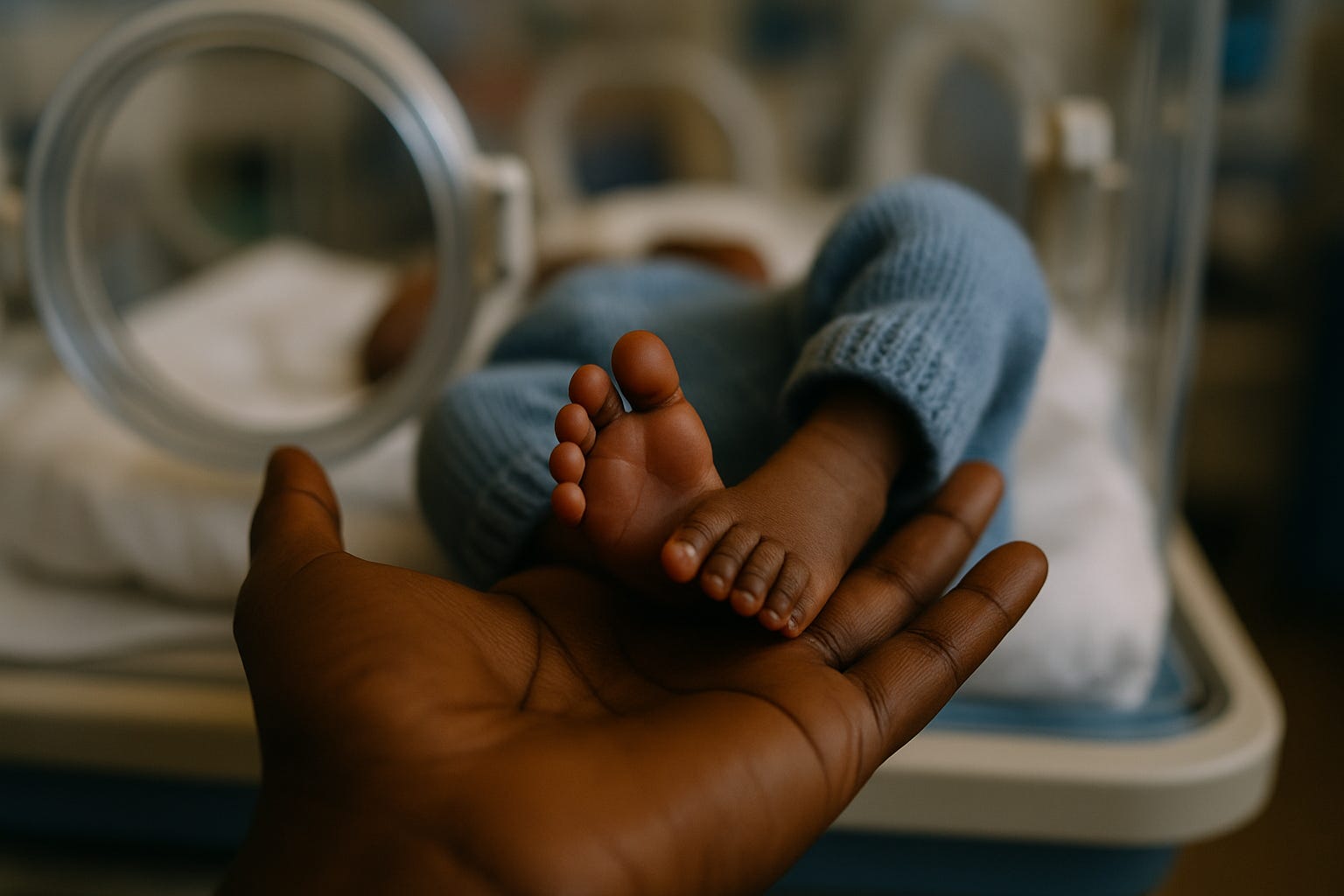
Six months after his premature birth, Baby Chance remains hospitalized. He now weighs 11 pounds and is being transferred to another facility for specialized care. His grandmother, April Newkirk, asked the public for prayers—not outrage, not political mobilization.
That was the November 24th update.
Within weeks, however, “reproductive freedom” advocacy groups reframed her words as proof of political atrocity. “Devastating update,” they declared—not because Chance is worsening, but because he is still alive, still growing, still receiving care, and still costly. Once again, Adriana Smith’s death was converted into a weapon against a law that never governed her case.
For readers who want the full legal and medical background, I’ve already covered it in “Weaponizing Heartbreak: What the Adriana Smith Coverage Gets Wrong” and “Not Forced Birth—A Mother’s Final Act.” The facts remain the same. What has changed is the continued refusal of national activist groups to accept them.
Earlier this year, Georgia Attorney General Chris Carr’s office stated plainly that nothing in the LIFE Act requires keeping a brain-dead woman on life support. Withdrawing life support is not legally considered an abortion unless the purpose is to end the pregnancy. Adriana’s situation was governed by Georgia’s 2007 Advance Directive for Health Care Act, passed during the Roe era. Because she had no advance directive and her baby was pre-viable at the time of her neurological death, physicians were required to continue life-sustaining treatment.
This distinction is a matter of public record. The insistence on blaming the 2019 “heartbeat bill” is no longer an error—it is a narrative choice.
What is especially revealing now is how Chance himself is being framed. Reproductive Freedom For All Georgia labeled his continued hospitalization “devastating,” blamed it on “inhumane” policy, and used Newkirk’s update as a springboard for legislative messaging. Yet her words contained no condemnation of the child—only fatigue, concern, gratitude, and faith.
The emotional framing is coming from political actors, not the family.
What we are witnessing is not simply disagreement over law. It is a worldview in which a surviving child becomes the problem that must be explained away.
There was a time when a premature baby’s survival was a medical challenge to be met, not a political story to be exploited. In the early twentieth century, most hospitals refused to care for infants born too early, labeling them a lost cause. It was not ideology that saved them—it was human stubbornness. Martin Couney, working outside the medical establishment, built incubator facilities at world’s fairs when hospitals would not. Parents who were told their babies would die brought them to him; Couney funded the care through public admission so families paid nothing. Thousands of premature babies lived because someone refused to accept that their lives were disposable.
Their survival was not framed as failure. It was celebrated as progress.
Today, a premature baby grows from under two pounds to eleven—and advocacy groups cast his care as a political indictment. That inversion should disturb anyone who believes medicine exists to preserve life where possible, not to adjudicate whose life is worth the effort.
In Nothing But Abortion, I wrote about how mainstream “feminist” advocacy has narrowed women’s interests into a single fixation on termination, while everything that safeguards women and children—medical accountability, maternal health, sex-based rights, informed consent—is treated as inconvenient. Adriana Smith’s case exposes that collapse with painful clarity.
Once she was declared brain-dead, there was no abortion decision left to make. The pregnancy already existed. The only question was whether her child would be allowed to continue developing. Georgia’s long-standing statutory default preserved that life in the absence of contrary instructions. Now that the child exists, the political machinery around abortion cannot easily absorb him—so survival must be rhetorically recast as harm.
That shift—from defending choice to resenting survival—cuts to the heart of this entire controversy.
Outrage, if anywhere, belongs with the medical system that failed Adriana when she first sought help. She presented multiple times with a severe headache, was medicated but not properly scanned, and blood clots were not ruled out. Days later, she was legally dead. This pattern mirrors other cases and raises questions about how pregnant women’s neurological complaints are triaged.
But confronting those failures requires holding modern medicine accountable. It is easier to blame a law that had no role in the life-support decision.
What should not be debatable is this: Chance’s continued hospitalization is not proof of cruelty. It is the ordinary reality of extreme prematurity. NICU care is costly, exhausting, and emotionally punishing—but none of that makes the child a policy mistake.
A society that once built incubators to save premature infants now issues press statements to condemn the effort. That reversal says more about our moral confusion than it does about Adriana Smith, her family, or the law.
Adriana’s death remains a tragedy. Her son’s life is not.
The legal framework has been misrepresented for months. The continued distortion is strategy, not confusion. And when advocacy organizations begin treating surviving premature babies as political “harm,” they reveal just how far “reproductive freedom” has drifted from anything resembling reverence for life, women, or motherhood.
Prayers for Chance are not extremism. Life-sustaining care is not barbarism. And survival should not have to justify itself in the language of politics.
Regardless of where you fall politically, a baby born at 25 weeks is still fighting to stabilize himself months later. The family’s GoFundMe is linked here for those who wish to help with medical and living expenses during their long season of waiting.
Thank you Kristen. You bring moral clarity to a situation that is tragic on so many fronts. Went right to the GoFundMe page to donate. My prayers are with baby Chance and the rest of Adriana’s family. 💙
Very much a tragic story. I had not heard of this case, all that I have learned is from what you have written here. The family assuming the responsibility is what I think is the natural response. Not knowing if the mother had already discussed who cares for her child in her absence (like some parents do, after the child is born eg godparents) since the mother's unexpected death was while still pregnant. As for any persons couching the reality of this very human situation in any light other than compassion... some folks tend to show who they really are in the presence of difficult situations.