


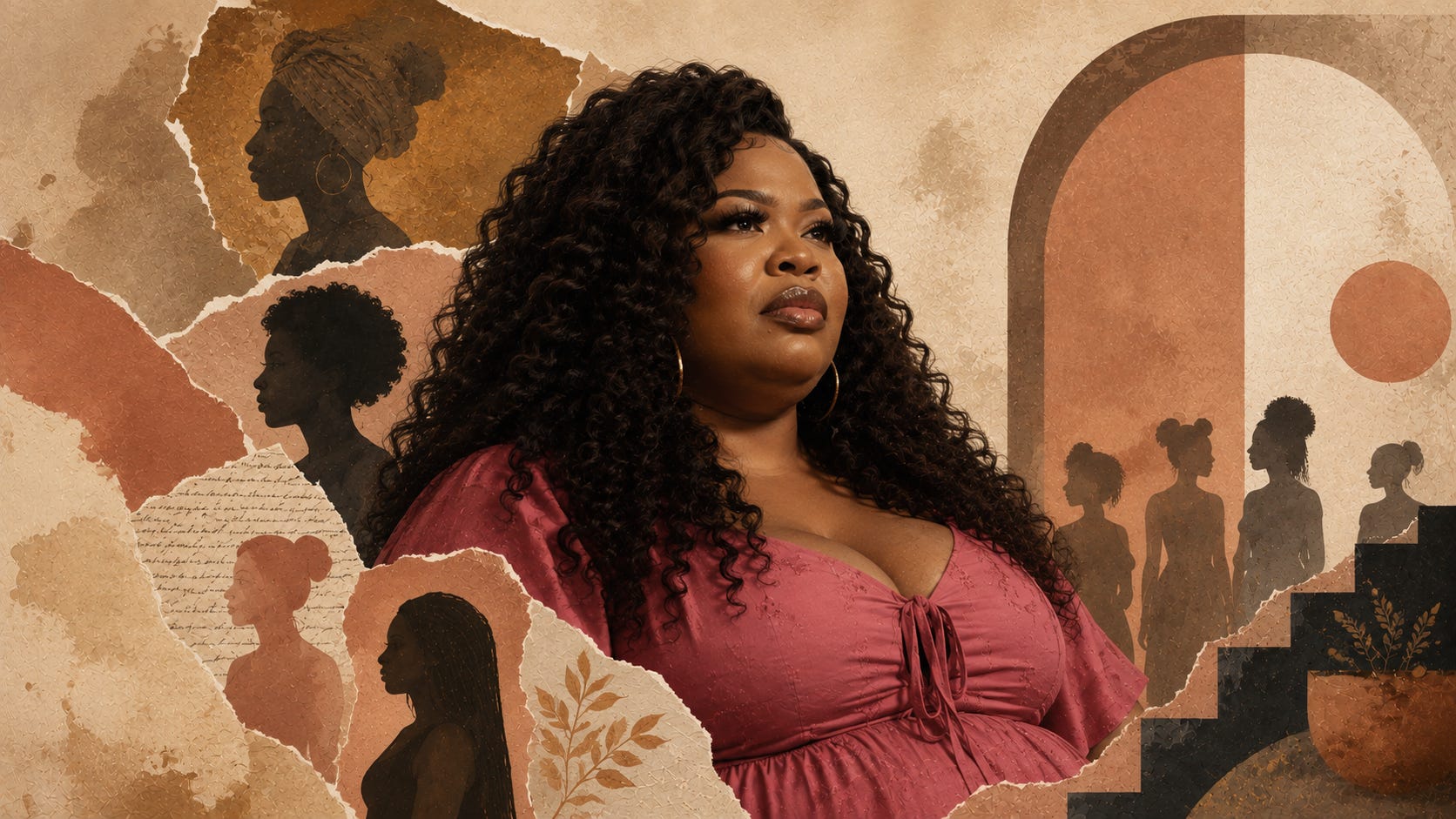
Last week, during a recorded panel discussion about Millennial and Gen Z Black women and gender identity ideology hosted by Lorraine Nowlin, A'Ja Lyons made an observation that Black women are often used as a rhetorical entry point for gender ideology because we are at the bottom of the social hierarchy. I agree that we are the women whose history can be invoked to make almost any argument about inclusion sound morally urgent. Question whether a man can become a woman, and eventually someone will reach for us: If trans women aren’t women, then Black women aren’t women.
I have seen variations of that argument more times than I can count, but something clicked for me during that conversation. I have watched this happen from two directions. I am a Black woman and I am also a fat woman, and in both spaces I have watched women’s bodies, histories, insecurities, and hard-won social gains repurposed to make an argument for including men in something women built for ourselves.
But there is a problem with the familiar analogy about Black women. Black women were never oppressed because society didn’t see us as female. In fact, much of our oppression depended on the fact that it did.
Our Femaleness Was Never Ambiguous
American slavery provides perhaps the most brutal example. Enslaved Black women’s reproductive capacity had economic value, and children born to enslaved women inherited their mothers’ enslaved status. Black women could be denied bodily autonomy, sexual innocence, protection from male violence, and the privileges of respectable femininity, but their femaleness was never ambiguous. Quite the opposite…Black women were female enough to exploit while being denied many of the protections supposedly attached to being female.
That distinction matters because gender ideology repeatedly collapses two very different propositions: that society has narrow ideas about what a woman should look like and that there is therefore no objective reality to what a woman is. Those are not the same thing. I’ve written before, in Beyond Tokenism and From Representation to Erasure, about the use of Black history and Black female imagery to lend gender ideology moral weight. The message to Black women is always some variation of: You of all people should understand.
But understand what, exactly? That stereotypes about Black women were wrong? Absolutely. That femininity should not be synonymous with whiteness, thinness, submissiveness, delicacy, or conventional beauty? Of course. That those stereotypes somehow prove male people can be women? No…never.
Black women never needed the definition of woman expanded to accommodate us. We needed the definition of femininity loosened enough to stop punishing women who didn’t conform to it. And I know that because I have watched essentially the same maneuver happen to fat women.
I explored the same pattern in Hijacked Sanctuaries, this time in plus-size women’s spaces. The histories are obviously different, but the rhetorical maneuver is familiar. A movement built around the proposition that women’s bodies come in many forms quietly becomes transformed into the position that any body can be a woman’s body. Those statements sound superficially similar, but they aren’t. Neither fat women nor Black women needed womanhood redefined to include us. We needed the stereotypes and hierarchies imposed upon female bodies dismantled.
And there may be no better illustration of what gets lost when those distinctions disappear than something I watched happen on reality television a few years ago.
When Violence Becomes Entertainment
Sometimes popular culture reveals a hierarchy more clearly than an academic paper ever could. In Episode 37 of Love After Lockup season four, Gabby Nieves discussed violence she suffered at the hands of her husband, Chris. The assault occurred off the show but the show appropriately treated her account seriously, displaying information directing viewers experiencing domestic violence toward help, including a hotline number.
Seven episodes later, Monique Robinson—a fat Black woman—became involved in a physical altercation with the “sisters” of Derek, the man she was dating. One of those siblings, “Elizabeth,” is male and identifies as a woman. This confrontation was actually shown, advertised as an “explosive first meeting” and packaged as the kind of chaotic spectacle reality television knows how to sell.
During the fight, “Elizabeth’s” lingerie shifted and his penis became exposed, requiring the editors to blur it. The male body itself became impossible for television to ignore because the network literally had to censor it.
The circumstances were not identical: Gabby was describing brutal intimate-partner violence, while Monique’s confrontation involved Derek’s male sibling. I don’t know what reasoning went into the producers’ decisions, but the contrast is worth examining. The show had already demonstrated a sensitivity to male violence against women. What happens to that sensitivity when acknowledging the physical reality on screen would also require acknowledging that the person fighting women is male?
That question has stayed with me because the political abstraction suddenly had a body: a fat Black female body. Monique sat at the intersection of the two groups whose experiences I had already watched being used to make gender ideology sound more inclusive. But when a fat Black woman’s physical vulnerability requires recognizing that the body confronting hers is male, those same boundaries become inconvenient.
Woman Enough for the Analogy
Black womanhood is extraordinarily valuable as a rhetorical resource. Our history establishes the moral stakes, our experiences supply the discrimination analogy, and our exclusion can be invoked to demand somebody else’s inclusion. We are woman enough for the analogy.
But what happens when recognizing our vulnerability requires acknowledging the very biological distinction we have been told is exclusionary? What happens when the Black woman’s interests conflict with those of a male person claiming a female identity, or when the plus-size woman says body acceptance does not mean male bodies belong in her changing room? Who is expected to move? Increasingly, it seems to be the woman.
That is why I am less interested in deciding who sits at the bottom of the totem pole than I am in asking another question: Which women are easiest to convince that having boundaries is a form of cruelty?
Black women know what racism and exclusion look like. That history should make us perceptive; it should not obligate us to pretend that every boundary is segregation or surrender our ability to distinguish one form of oppression from another. Racism is not sexism, and sex is not race. Neither Black women nor fat women require a theory of gender identity to explain why we fall outside narrow ideals of femininity. We merely require a definition of woman broad enough to encompass every kind of female person without becoming so broad that it ceases to mean female at all.
During Friday’s panel, another thought stayed with me: as Black women, sometimes we’re all we’ve got. I don’t take that to mean retreating into ourselves or refusing solidarity with anyone else. I take it as a reminder that solidarity cannot require self-abandonment. There is nothing progressive about teaching women that our boundaries are immoral or liberating about invoking Black women’s oppression to support an ideology that asks us to pretend sex has no political significance when so much of our history demonstrates precisely the opposite. Our foremothers did not suffer because female biology was meaningless; their female biology shaped some of the particular forms their oppression took. Our bodies matter because material reality matters.
When society recognizes our womanhood when it needs our history, our bodies, or our moral authority to advance someone else’s cause—but suddenly finds our sex negotiable when we ask for boundaries of our own—we should notice. Black women have always been woman enough: woman enough to labor, woman enough to reproduce, woman enough to suffer misogyny, and woman enough to become everybody else’s civil-rights analogy.
We should not have to become useful to someone else’s politics before we are woman enough to protect.
Watch the Conversation
This essay grew in part from a conversation I had with other Black women about these questions. “Are Millennial and Gen Z Black Women Coerced Into Accepting Gender Identity Ideology?” premiered today.
As I said during the panel: Solidarity without boundaries becomes just becomes self-erasure.
One place that is Ground Zero for this is women's prisons.
“But it seems so complicated, Kristin. Why not just believe people when they tell you who their authentic self is?”
🤮
Thank you for your efforts in the fight for the most vulnerable — including the very people who are clamouring to rollback your rights whether based on their own confusion, mental illness, and/or misogyny 🙏