



This election cycle has been exhausting, and I suspect I’m hardly alone in being ready for it to end. For months, Georgians have endured advertisements, text messages, and mailings full of accusations and warnings that whatever reservations we have about one candidate, the other is simply too dangerous to elect. Our political parties have demanded loyalty while offering little reason to feel enthusiastic about the choices before us.
But as Election Day approached, a story emerged from Georgia’s basketball courts that captured something I’ve been thinking about throughout this campaign. The Atlanta Dream came within five points of winning their first WNBA championship, falling 68–63 to the Golden State Valkyries in Saturday’s decisive Game 7. Their remarkable postseason deserved celebration, yet much of the Finals was overshadowed by controversy over where—and when—the team could play. Somehow, even that became another occasion for political point-scoring over women’s sports.
And after months of being told which political compromises I ought to accept, I've found myself thinking about what it means to support women without first asking which party benefits.
The Dream Deserved Better
The Dream’s championship run exposed a mismatch between the growing popularity of women’s basketball and the infrastructure available to support it. Their regular-season home, Gateway Center Arena in College Park, accommodates approximately 3,500 spectators. State Farm Arena, home of the Atlanta Hawks, can hold roughly 17,000. With demand sufficient to fill the larger venue, moving the Finals games downtown made sense. But the arrangement proved considerably more complicated than it should have been. Scheduling conflicts forced adjustments throughout the series. Game 6 was moved from Thursday evening to 12:30 that afternoon so the Dream could play at State Farm Arena rather than return to their smaller home venue. The game sold out anyway.
Dream ownership said it had raised concerns about potential scheduling conflicts months earlier, without receiving the urgency those concerns deserved. To their credit, the Hawks and arena officials made accommodations, and the Dream are expected to make State Farm Arena their permanent home next season. Those are encouraging developments. But why did a team competing for a professional championship have to scramble for a venue worthy of the occasion?
Not every scheduling conflict is evidence of discrimination. The logistical difficulties were real, and some reflect a league whose popularity has outpaced its arrangements. Still, women’s sports cannot continue to be treated as a pleasant surprise that institutions figure out how to accommodate once the crowds arrive.
The Dream earned their place on that stage. Their fans demonstrated that the demand was there. The planning should have reflected both.
A Convenient Definition of Supporting Women’s Sports
As the venue controversy unfolded, Georgia State Representative Ruwa Romman, who is currently a Democratic nominee for state senate, quote-tweeted a report that the Dream might be forced to play their Finals home games at the 3,500-seat Gateway Center Arena because State Farm Arena was already booked. Her commentary? “Deafening silence from the ‘protect girls’ sports’ crowd on this.”
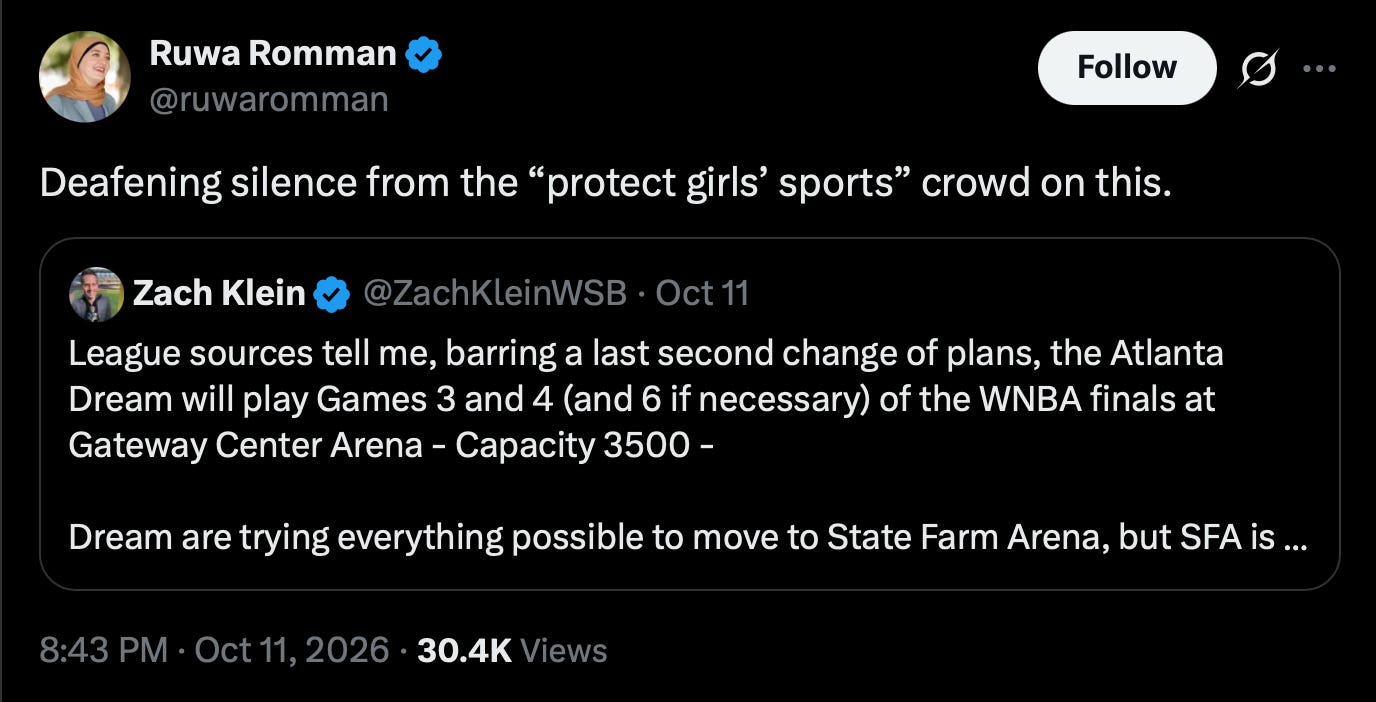
I found the remark disappointing, not because the Dream’s predicament was unworthy of criticism, but because Romman turned a legitimate concern about women’s sports into an opportunity to question the sincerity of people advocating sex-based protections.
And perhaps some of those advocates were silent. If so, it’s fair to ask why. But their silence wouldn’t make their concerns about fair competition any less legitimate, just as Romman’s opposition to sex-based protections wouldn’t make her criticism of the Dream’s venue situation any less valid. A high school girl who wants a fair race and a professional basketball player who wants a suitable arena aren’t asking for contradictory things. Both are asking that women’s sports be taken seriously.
Protecting women’s sports should mean more than deciding who gets to compete. It should also mean ensuring that the women who compete have opportunities and facilities worthy of their talent. These are complementary obligations, not competing priorities. It is entirely possible to support the Atlanta Dream while believing female sports should remain female. Anyone serious about the long-term success of women’s athletics ought to be capable of doing both.
What Standing Up for Women Actually Looks Like
Last Thursday, I attended an interview hosted by Women’s Liberation Front with women’s rights activist Amy Sousa. The conversation explored political theater as a strategy for challenging a media environment that often overlooks women’s concerns, including the recent protest at a Portland Thorns soccer match and the Camas High School girls who walked out of a cross-country race.
The Camas girls refused to compete in protest of a male student participating in their female athletic category. Their decision carried consequences for their own participation, but they made it anyway. At the Thorns match, women advocating sex-based protections displayed their message in a setting where they knew it would be controversial, drawing confrontation and public attention. What struck me wasn’t simply the tactics, but the willingness to act. These women weren’t waiting for a political party to decide whether their concerns were convenient. They were making themselves heard.
Political theater can be dismissed as attention-seeking, but when established institutions seem unwilling to listen, public demonstrations can become a way to force an issue into the conversation. That is rather different from politicians using women’s sports to score points against their opponents. The Camas girls were defending what they believed to be the integrity of their competition. The Atlanta Dream were seeking accommodations appropriate to the championship they’d earned.
Different circumstances, different demands, but a common expectation: women’s athletic interests deserve consideration on their own merits. Neither group should become a prop in someone else’s political argument.
A Woman Governor Isn’t Necessarily a Victory for Women
That brings me back to Georgia’s election. Democratic gubernatorial nominee Keisha Lance Bottoms has said she would have vetoed Georgia’s Riley Gaines Act, which protects female school sports and establishes sex-based definitions in state law. For a candidate who could become Georgia’s first woman governor, that raises a question: What does female representation accomplish if the woman elected opposes the legal recognition of sex on which women’s protections depend?
In the closing weeks of the race, Bottoms received substantial financial support from Illinois Governor JB Pritzker and former New York Mayor Michael Bloomberg. Both have publicly supported policies expanding legal recognition and protections based on gender identity. Pritzker has signed legislation establishing a process for self-selected gender markers on state identification, while Bloomberg has supported the federal Equality Act and protections for access to facilities based on gender identity. I can’t establish that Bottoms’ opposition to the Riley Gaines Act prompted their support, but I wonder whether publicly opposing sex-based protections served as a signal to powerful donors whose political interests align with that position.
When opposition to sex-based protections aligns with the priorities of influential funders, whose interests are being rewarded, and whose are being represented? Bottoms has proposals on healthcare, housing, childcare, and education that deserve consideration, but electing a woman doesn’t automatically advance women’s rights, particularly when she opposes protections that are fundamental to them.
Republicans don’t earn unconditional loyalty simply by defending female-only sports categories, either. Fair competition matters, but so do the facilities, resources, and opportunities female athletes need to compete. One party cannot claim to champion women’s sports while overlooking the women playing them. The other cannot celebrate female athletes while dismissing the importance of female-only competition.
Women deserve better than either.
The Election Ends. The Work Doesn’t.
This is my first election as a mother, and in three days, my daughter will turn one. The last essay I wrote before she was born challenged the hypocrisy of men who preached family values while refusing the accountability those values demand. My first essay afterward examined what happens when women discover that their political loyalty offers little protection from the men they’ve supported. Nearly a year later, I find myself confronting much the same questions, only now with a daughter whose future will be shaped by the answers.
Perhaps that’s what has exhausted me most about this election. Not simply the candidates or endless campaigning, but the expectation that women should accept whatever portion of our interests a political party finds convenient to defend, then demonstrate our gratitude by overlooking the rest.
I want my daughter to grow up with opportunities that are fair, well-supported, and taken seriously. If she wants to play basketball, run track, or pursue something I haven’t considered, I want her to know that her sex won’t be treated as an inconvenience and her ambitions won’t be treated as an afterthought. I want her to understand that she can disagree without betraying anyone, and that her dignity isn’t conditional on her usefulness to a political movement. I believed women deserved those things long before becoming a mother. I believe it even more strongly now.
As this election closes, I’m reminded of something from the conversation with Amy Sousa: the importance of showing up in our own ways, even when that doesn’t mean standing on the front lines. The work requires more than waiting for the right politician to win. It requires women willing to articulate our interests, defend them publicly, and hold institutions accountable regardless of which party controls them.
By tonight, the votes will have been cast. We may not know every result, but at least this exhausting campaign will be behind us. Whoever wins will inherit responsibilities that cannot be fulfilled with campaign slogans, symbolic representation, or selective concern for women.
This election cycle may end today, but our expectations shouldn’t.